

Approved articles for this Benetti Yachts issue.
Before Benetti became a name associated with superyachts, it belonged to a working boatyard in Viareggio. In 1873, Lorenzo Benetti acquired the Cantiere Darsena Lucca and began a business serving a maritime world of sailing vessels, coastal trade and practical shipbuilding. The distance between those beginnings and today's large custom yachts is the story of a company repeatedly finding new ways to build.
Lorenzo's sons Gino and Emilio continued the family business. The early fleet included several types of sailing craft, reflecting the needs of the Mediterranean's working economy. Shipbuilding was a trade embedded in the town: knowledge passed between generations, while each new vessel required materials, skilled labour and an understanding of life at sea.
The transition to powered vessels and new construction materials changed that world. Benetti's move from wooden construction towards steel helped shape its development as a motor-yacht builder. By the 1960s, the business was creating boats for a very different kind of voyage, one in which private accommodation and leisure became as important to the brief as the vessel's working capability.
The Gabbiano 22M, introduced in 1966, belongs to that transformation. Its place in the company's history connects a compact luxury motor yacht with the broader appeal of the Italian-built private vessel. The proportions of these earlier boats are also a reminder that a distinctive yacht does not depend on the extraordinary lengths associated with today's largest projects.
Nabila brought another scale of ambition. The 86-metre yacht became one of the most recognisable names in Benetti's history and appeared in the 1983 James Bond film Never Say Never Again. Beyond the glamour, a project of that size required the yard to bring engineering and accommodation together on a very substantial platform.
A decisive change followed in 1985, when Azimut founder Paolo Vitelli acquired Benetti. The combination brought two different histories into one group. Azimut had developed its own approach to motor yachts; Benetti brought the heritage of a long-established shipyard. Keeping those identities distinct while building a larger organisation became part of the group's continuing character.
The acquisition of Livorno's Fratelli Orlando shipyard in 2003 expanded the physical possibilities. The site had a history of commercial and naval construction, and its addition gave Benetti a new setting for larger projects. Viareggio and Livorno became complementary places within the business, each carrying the practical culture of an Italian working waterfront.
Engineering continued to push the story forward. The 65-metre Ambrosia III brought together diesel-electric propulsion and Azipod units, showing how a yacht's technical choices could become part of its identity. The interest was not confined to appearance: the machinery and the way it was arranged offered another route for development.
Design partnerships also became an important part of the modern company. Nataly, a 65-metre project, marked the beginning of Benetti's collaboration with RWD in 2011. That relationship would later contribute to the Oasis approach, where the aft deck becomes a broad living environment closely connected with the sea.
The 2019 period known as Benetti's Giga Season brought Lana, Luminosity and IJE into the story at lengths of more than 100 metres. Building several yachts on that scale demonstrates how far the organisation had travelled from the original Viareggio yard. It also highlights the number of disciplines involved: design, structures, systems, interiors and a large network of specialist work.
In 2023, the company marked 150 years of shipbuilding with events that brought the history back to its yards. The anniversary was an opportunity to see the business as a sequence rather than a single style. Sailing vessels, classic motor yachts, large custom commissions and contemporary families all occupy different chapters of the same name.
That continuity gives Benetti its particular appeal. The heritage is tangible, but it has never required the product to stand still. The interesting thread is the willingness to change the scale, material, machinery and arrangement of a yacht while retaining a connection with the places and people who build her. A Tuscan beginning remains visible within a much wider horizon.
About From a Tuscan boatyard to the world's oceans
Enquiries are not enabled yet. No message will be sent.

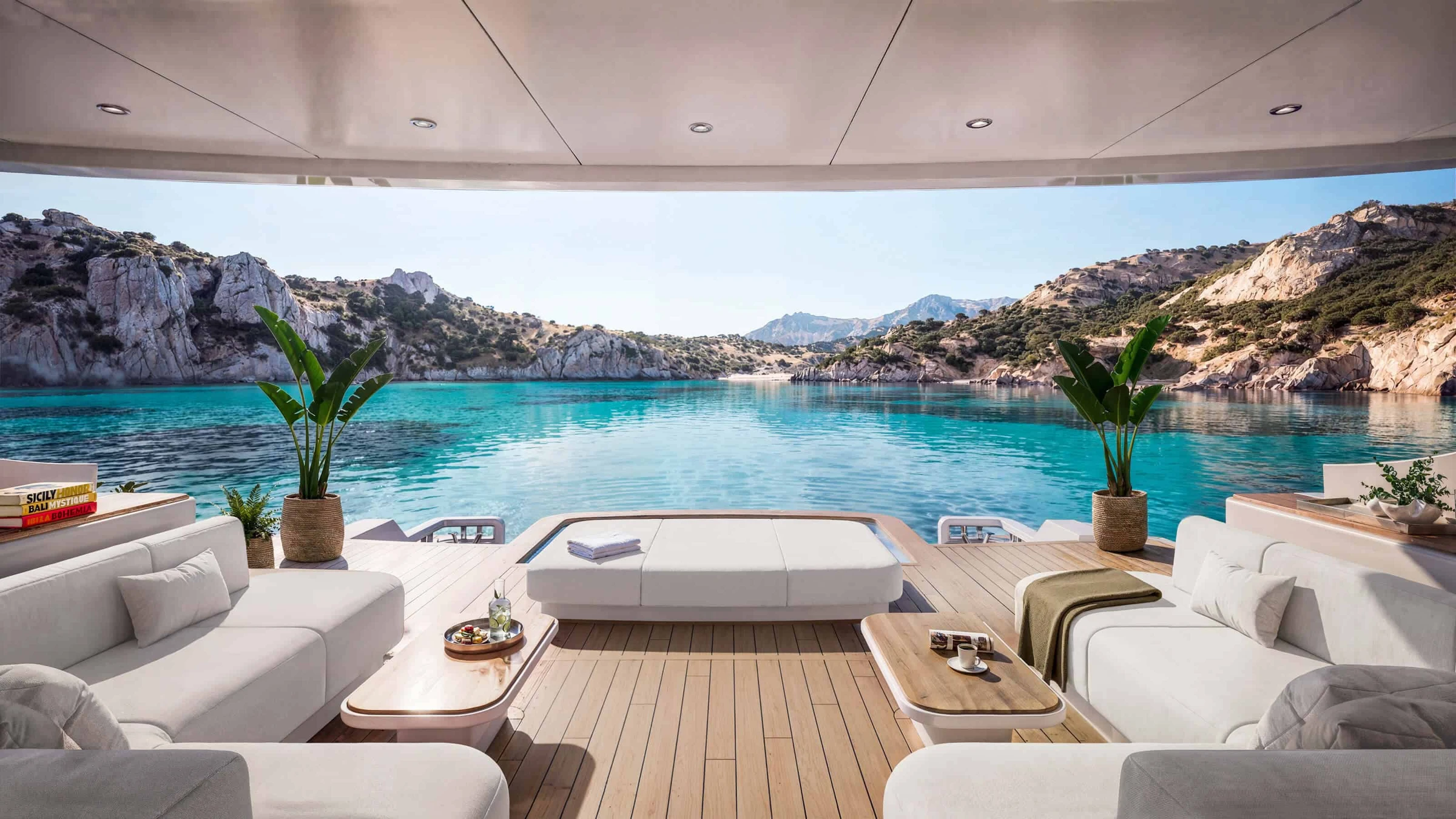
The most revealing way to read the Oasis 36M is from the stern. Rather than treat the aft end as a narrow terrace behind the main saloon, the design makes it a substantial living environment. The sea becomes part of the arrangement, shaping how people gather, move between spaces and spend a day on board.
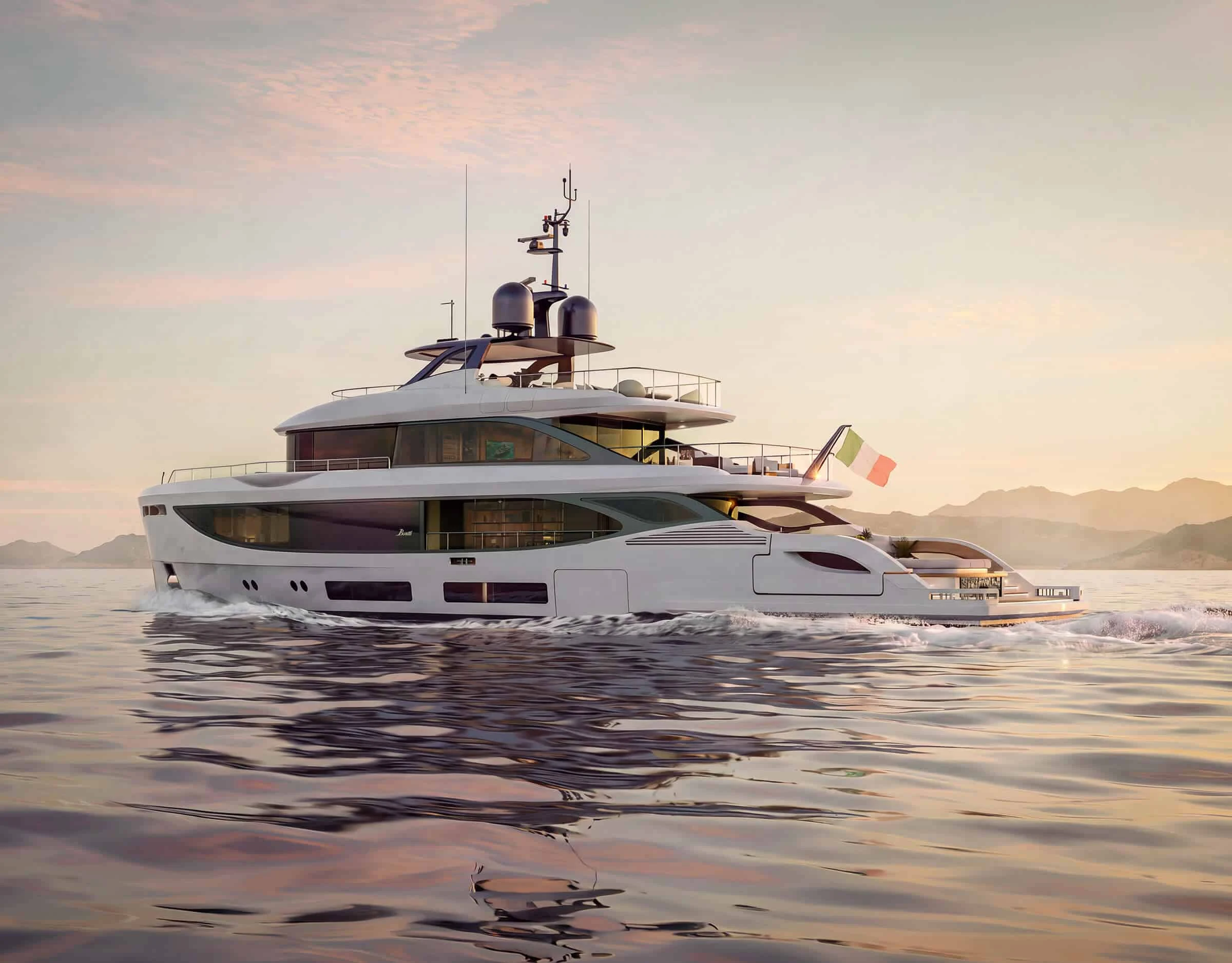
The 35.60-metre model brings together exterior design and concept by RWD, interiors by Bonetti/Kozerski Architecture and naval architecture developed within Benetti. Its proposed accommodation provides five cabins for ten owners and guests, with separate space for seven crew. Within those dimensions, the central design question is how to make the yacht feel open without losing the practical organisation required to run it.
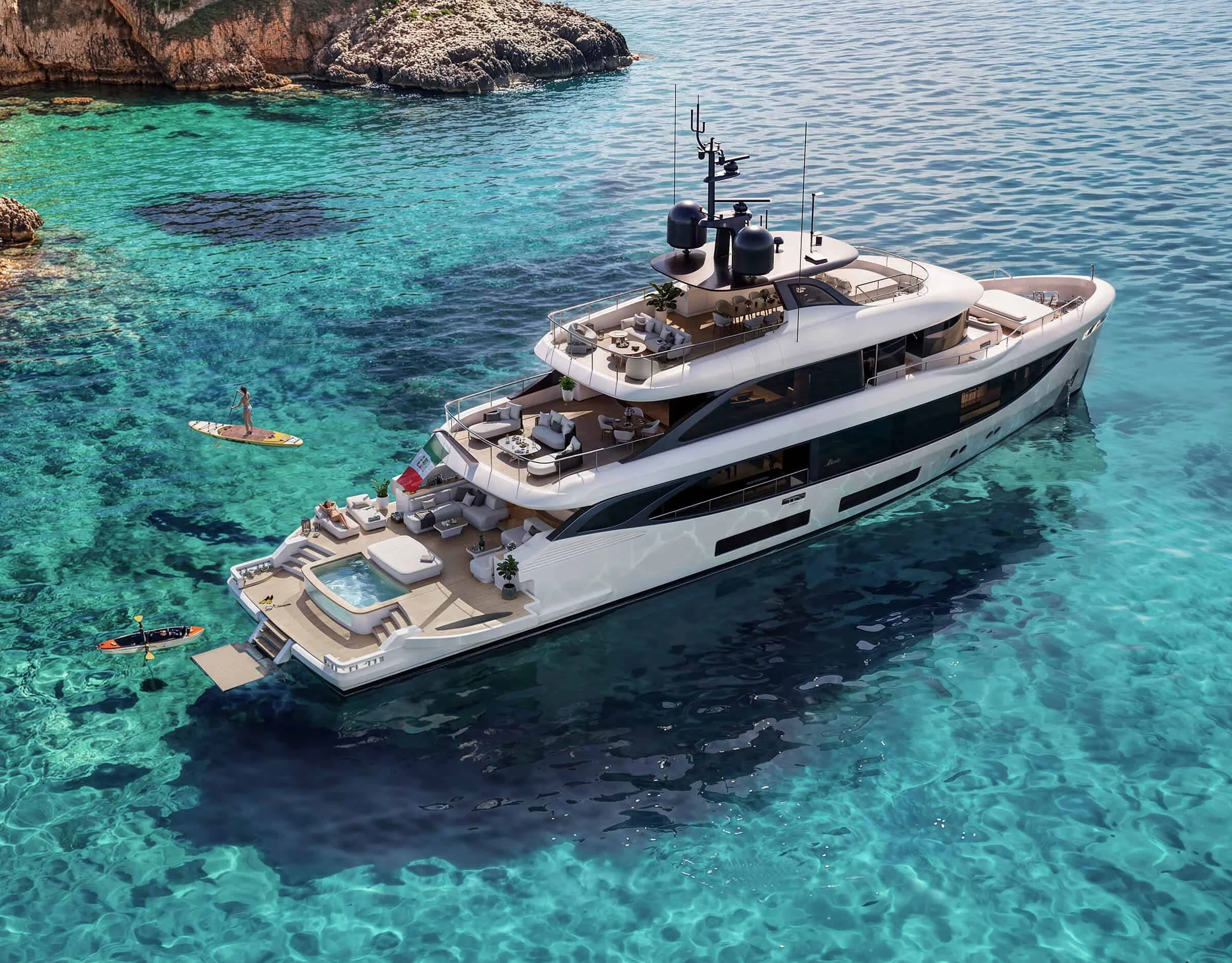
The Oasis Deck is the clearest answer. The 82-square-metre aft platform expands through folding side wings, opening a broader relationship with the water. Moving the tender garage further forward allows the stern to be given more fully to guest use, rather than forcing leisure space to share every moment with the operation of launching and recovering equipment.
At the centre is a pool of 5.5 square metres. A sliding cover allows the same area to become additional deck space, so the arrangement can change with the occasion. Two L-shaped sofas encourage people to sit facing the sea and one another. The emphasis is on an adaptable place to spend time rather than one fixed, formal view.
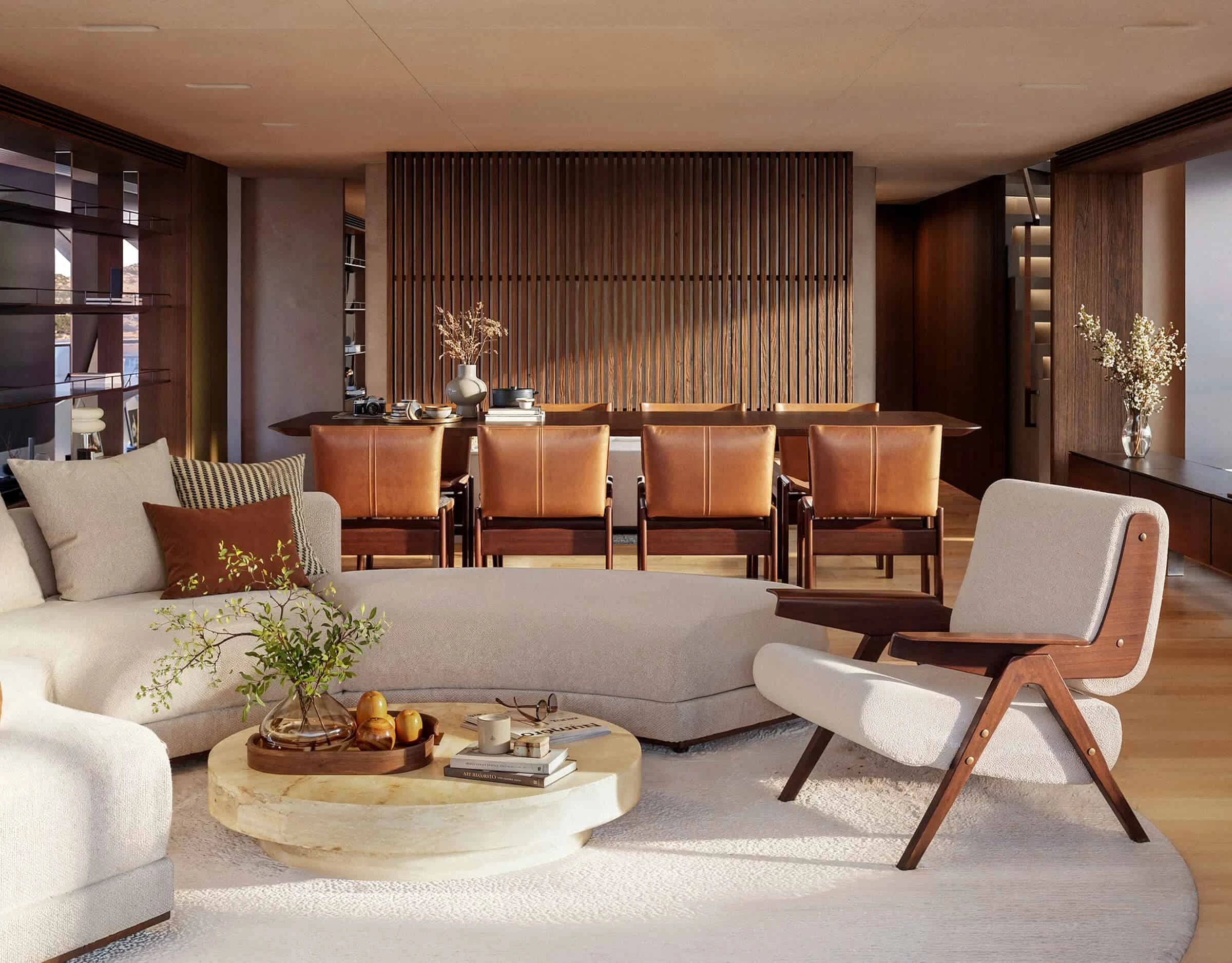
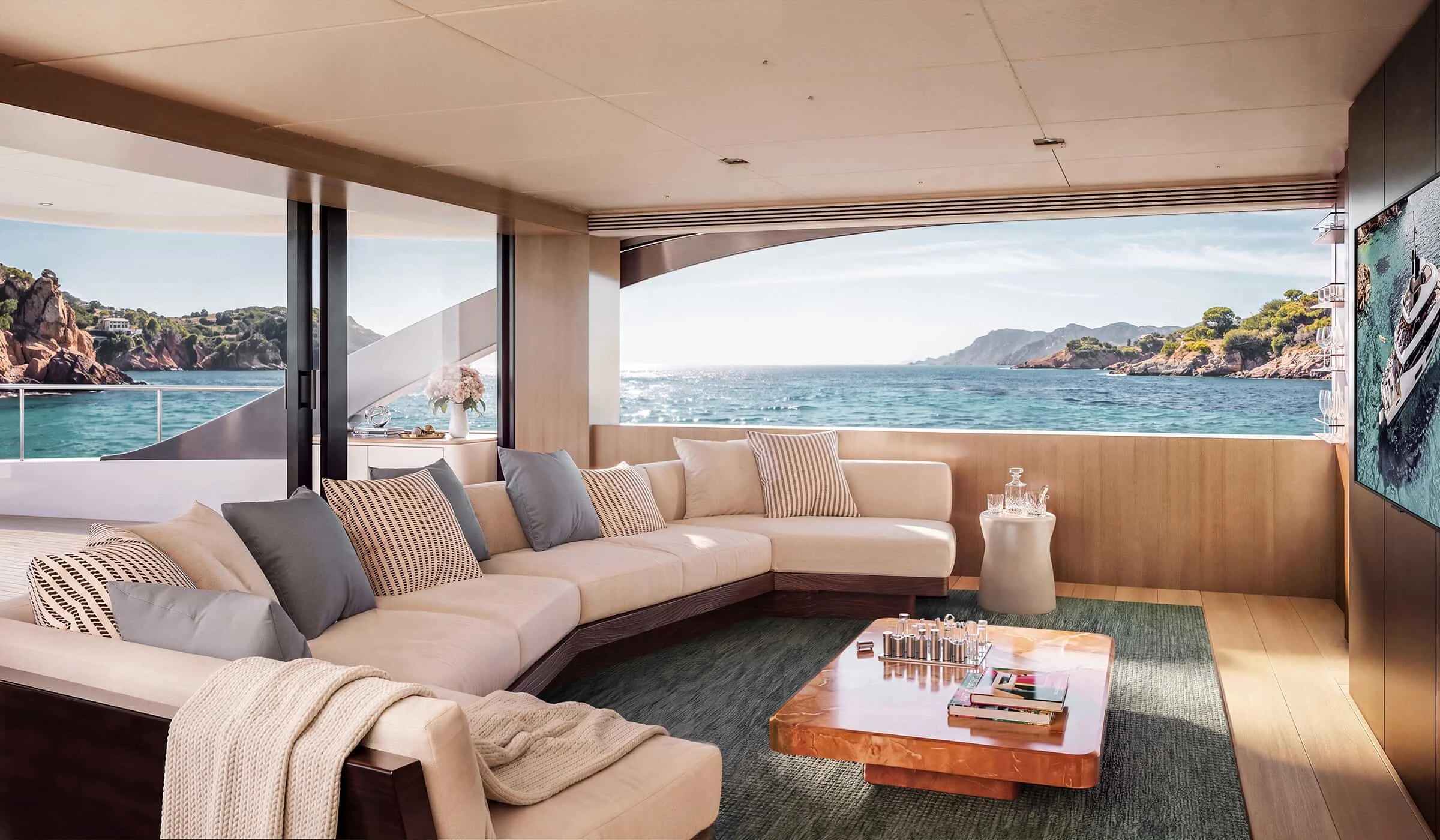
The connection continues into the main saloon. Its lounge is positioned aft, with dining further forward and the galley and pantry arranged to support service. Large mirrored windows admit light and broaden the view. A modular bookshelf helps organise the room without turning it into a succession of closed compartments.
Two alternative furniture and layout arrangements give an owner scope to adjust the balance between dining and relaxation. That is a small-sounding choice with a substantial effect. A yacht used for frequent formal meals may need a different emphasis from one where the main gathering place is an informal lounge after a swim.
The owner's suite explores the same interest in outlook. The bed faces towards the bow, with glazing on either side and storage integrated to preserve a sense of openness. A window-side desk or vanity adds another way to use the room. The aim is a private space that remains connected with the setting outside rather than feeling withdrawn from it.
On the upper deck, the skylounge provides a quieter alternative to the main social areas. Its 34-square-metre plan includes a pantry and bar, while the adjoining aft terrace offers room for outdoor dining or lounging. Different levels of the yacht can therefore support different moods at the same time, an important quality when several guests are living together.
The sundeck adds another generous outdoor setting, with approximately 65 square metres and more than 13 metres of length. Loose furniture makes the arrangement flexible, while an optional Jacuzzi introduces a further leisure choice. The design is less about prescribing one perfect use than allowing the owner to decide how the day should unfold.
Below those visible spaces lies the engineering that supports them. Benetti's research and development team has developed the hull form, including a submerged bulbous bow. Fuel and waste-water capacities are part of the cruising brief, linking the yacht's attractive anchorage life with the less visible systems required to sustain it.
The design interest of the Oasis 36M is the way these elements reinforce one another. Moving equipment changes the space available to guests; opening a side changes the view from a sofa; a pantry can make an upper lounge more useful. None of those decisions exists entirely on its own.
Taken together, the model presents a particular interpretation of contemporary yacht living: sociable, open and adaptable, with several places to gather and several ways to retreat. The attraction lies in that whole pattern, from a first step down towards the water to a quiet moment in the skylounge. The architecture is organised around what people might actually want to do.
About Oasis 36M: a different relationship with the water
Enquiries are not enabled yet. No message will be sent.
A contemporary Benetti is the product of several kinds of knowledge. Family history supplies one strand, management another, while designers, engineers and the yard's skilled trades turn the brief into a yacht. Looking at those people and disciplines makes the business more interesting than a list of dimensions or finishes.
The earliest names are Lorenzo Benetti and his sons Gino and Emilio, who connect the company to Viareggio's shipbuilding culture. Their world was shaped by working vessels and the demands of building for the sea. The skills have evolved enormously, but the need to reconcile a client's purpose with the practical behaviour of a boat remains recognisable.
Paolo Vitelli's acquisition of Benetti in 1985 introduced another family history. The founder of Azimut brought an entrepreneurial motor-yacht business together with a much older yard. The resulting group created the setting in which Benetti could expand while retaining its own name, products and shipbuilding identity.
Today, Giovanna Vitelli chairs the Azimut|Benetti Group and Marco Valle is its chief executive. Those are group responsibilities, spanning more than the Benetti product line alone. Their place in the story concerns the organisation that supports investment, production and the continuing development of two distinct yacht brands.
The design partnerships bring a different set of names into focus. RWD's relationship with Benetti dates back to the 65-metre Nataly. On the Oasis 36M, the studio is responsible for the exterior design and concept. The work includes the profile, but its effect reaches into how the aft deck opens and how the yacht's principal spaces relate to one another.
That makes exterior design an exercise in living as well as looking. A line on a drawing can influence the height of a window, the protection offered to a deck or the way people move between levels. The most convincing profile is one that supports a useful and coherent arrangement behind it.
Enrico Bonetti and Dominic Kozerski founded their New York architecture practice in 2000. Their work extends beyond yachts to residential, hospitality and other architectural settings. Bringing that experience to Benetti introduces another way of thinking about a room: proportion, material and ease of occupation can matter more than an accumulation of decoration.
On the Oasis 36M, Bonetti/Kozerski's interiors give that approach a specific setting. The main saloon, owner's suite and skylounge have different purposes, yet they belong to the same architectural conversation. Furniture, storage and sightlines help the spaces feel related while allowing each to do its own job.
Benetti's in-house research and development team supplies the naval architecture. This is a distinct discipline from selecting the interior palette or shaping the superstructure. The hull, capacities and technical arrangement have to support the intended cruising pattern, while leaving room for the accommodation and service spaces that make the yacht usable.
Then come the people whose work is encountered directly on board: the trades responsible for structures, installation, joinery and the many details through which a design becomes real. A well-aligned panel or a carefully resolved junction may not command a headline, but a yacht is full of such decisions. Their cumulative effect determines how convincing the finished whole feels.
Crew are part of that design equation too. The Oasis 36M's plan provides separate accommodation for seven, and the galley and pantry arrangements recognise that a relaxed guest experience requires organised work behind it. Service routes and working spaces are not peripheral to luxury; they help make its apparent ease possible.
The modern Benetti therefore brings together several scales of thought: a group's long-term direction, a designer's architectural idea, an engineer's technical arrangement and a craftsperson's detail. Its strongest projects allow those contributions to read as one coherent yacht. The finished vessel carries the company name, but the story belongs to many people.
About The minds and hands behind the modern Benetti
Enquiries are not enabled yet. No message will be sent.
Use the company’s official website for business enquiries about this article.
Contact Benetti Yachts on its official website ↗
Via Michele Coppino 104, 55049 Viareggio (Lucca), Italy | +39 0584 3821 | info@benettiyachts.it
Livorno shipyard: Via Edda Fagni 1, 57100 Livorno, Italy | +39 0586 415600
Image credit: Oasis 36M design visual. Benetti Yachts. Original image and credit . Image may be cropped for the layout.