

Approved articles for this Palmer Johnson issue.

Palmer Johnson is a yacht name with a working-boat past and an unusually bold modern appearance. Its history reaches back to 1918, while its best-known contemporary designs use long, low profiles, curved surfaces and striking proportions to make an unmistakable impression. The interest lies in how far the design has travelled without losing its appetite for a distinctive boat.
The early business was rooted in Wisconsin's Sturgeon Bay, where Hans Johnson and Herman Gmack established a boatbuilding operation. Wooden construction and practical vessels belonged to a very different world from today's carbon-composite superyachts. The skills of the yard, however, provided the foundation for a name that would become closely associated with private yacht building.
The Palmer Johnson identity developed through the following decades as the company moved into larger and more ambitious leisure vessels. Sailing yachts formed an important part of that history before the later emphasis on fast motor yachts. It is a varied background, one that resists the idea that a long-established builder must always preserve one fixed product.
Material changes helped make those shifts possible. Wood, aluminium and advanced composites belong to different phases and different kinds of project. Each brings its own construction methods and design opportunities. The appearance of a yacht is partly the result of what its structure allows, and Palmer Johnson's story repeatedly returns to that relationship.
La Baronessa represents an important chapter in the company's larger yacht work. The 59.5-metre aluminium yacht was designed by Nuvolari Lenard, whose founders Carlo Nuvolari and Dan Lenard would have a significant association with the builder. Their work brought a strong design identity to yachts that needed to be recognised at a glance.
The SportYacht family made that identity especially clear. Models from 120 to 210 feet share a deliberately related appearance, with shaped glazing, sculpted curves and long outdoor areas. They were conceived as a family rather than a succession of unrelated boats, allowing a person familiar with one to recognise the logic of the others.
The details contribute to that recognition. A stainless-steel strip through a porthole, the form of an arch or the treatment of an aft deck can become a visual signature. These elements are small compared with the overall length, but they help a yacht retain a particular character when seen from different angles and distances.
The SuperSport direction took a further step. Its sculpted body and slender main hull, supplemented by sponsons, introduced a different way to connect appearance with hydrodynamics. The design was not simply a new styling treatment applied to a conventional arrangement; it involved reconsidering how the boat would carry its volume and interact with the water.
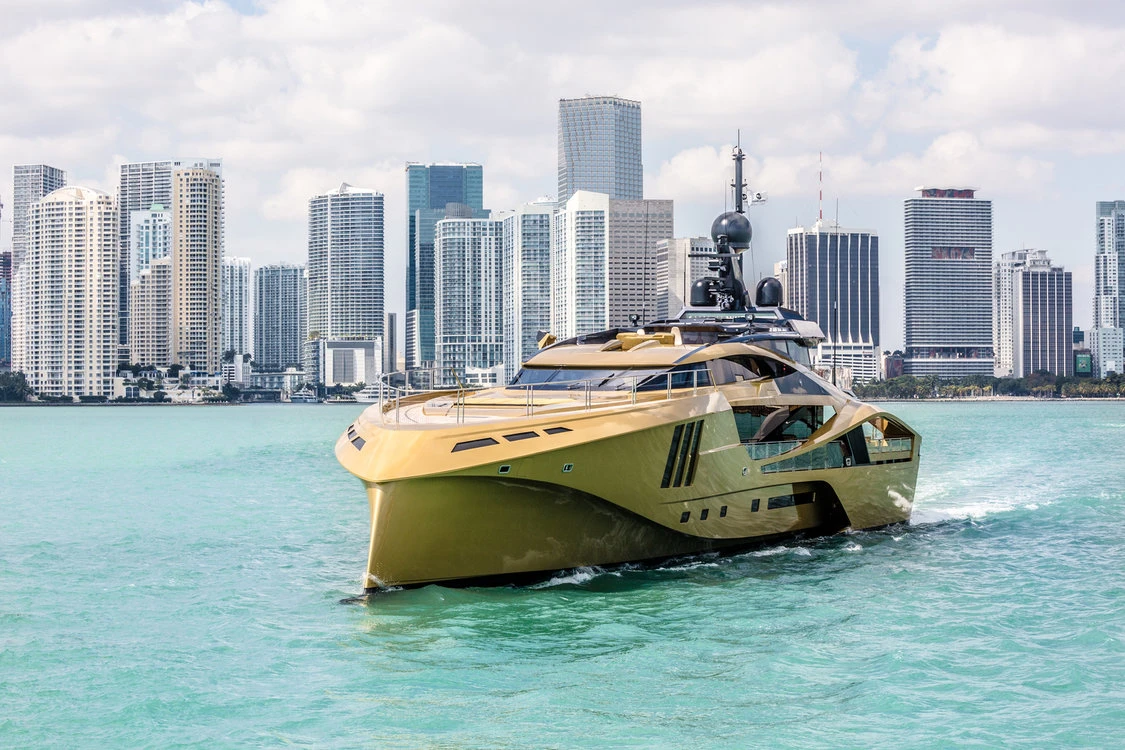
Khalilah, with her metallic-gold exterior, is one of the most recognisable expressions of that ambition. Her place in the company's imagery brings together bold colour, flowing form and a substantial composite structure. The visual confidence makes her memorable, while the engineering and arrangement explain why the project belongs within a broader design story.
The smaller PJ63 OpenSport carries a related interest into a 19.4-metre package. It demonstrates that the company's design language is not restricted to very large yachts. Broad beam, open social space and a sculpted exterior can be explored at another scale, with a different pattern of use and a different balance of accommodation.
The company's modern working geography includes Monaco and Pisa, while its heritage remains tied to the United States. That movement is another part of the story: a yacht name can carry its history into a new production setting, provided the design and technical capabilities continue to give it substance.
Palmer Johnson's appeal is therefore more than a dramatic profile. It is a record of changing materials, creative partnerships and attempts to give the owner a different experience. From the early wooden boats to the SuperSport concept, the recurring idea is a willingness to reconsider what the next yacht might look like—and how that appearance could be made real.
About A century of changing the silhouette
Enquiries are not enabled yet. No message will be sent.
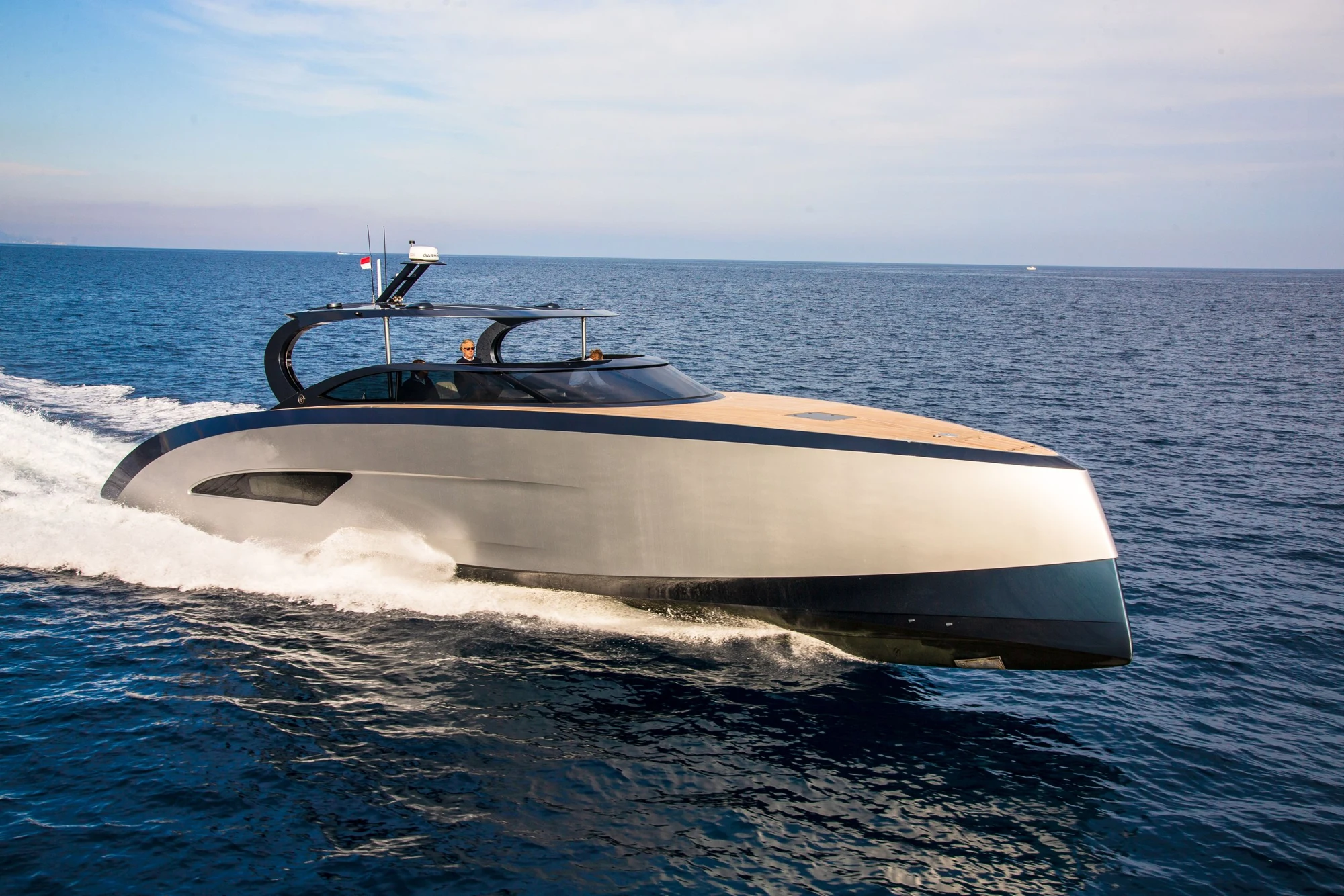
The SuperSport approach begins with a shape that refuses to look assembled from separate boxes. Curves run through the hull and superstructure, the shoulders are pronounced and the glazing is integrated into the overall form. Palmer Johnson describes it as a unified body; the useful question is how that sculpted exterior relates to the spaces and systems within.
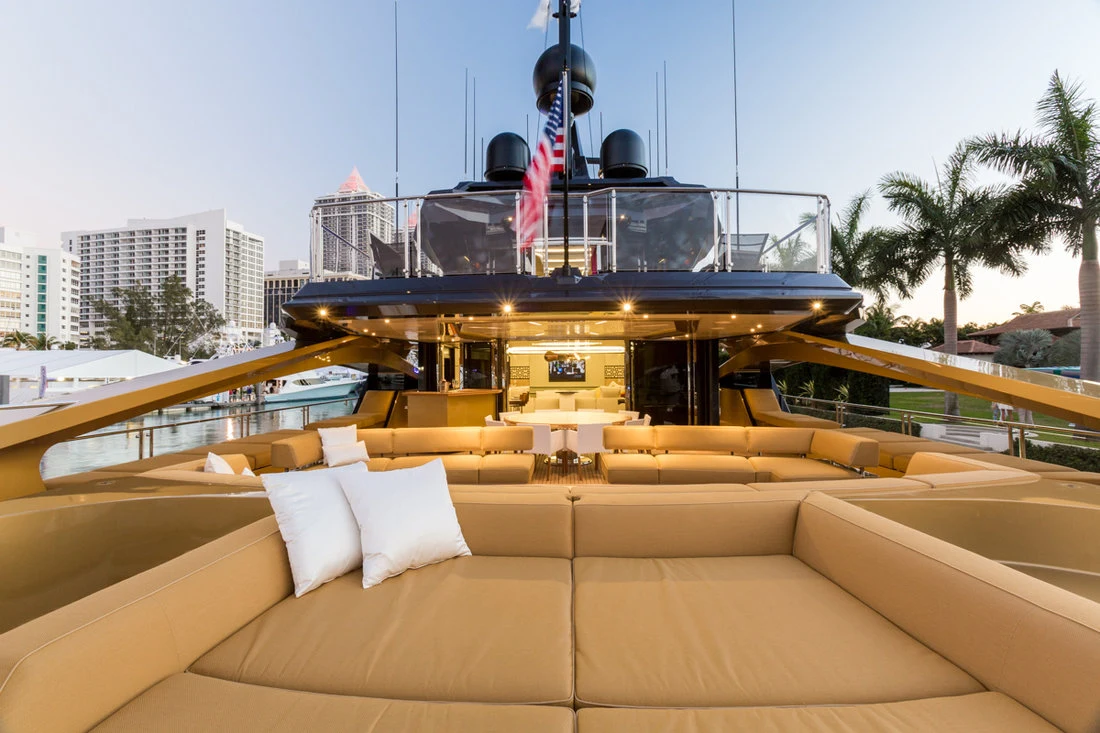
A slender main hull is combined with sponsons, extensions that contribute to the vessel's wider form and its behaviour in the water. This arrangement allows the central hull and the usable beam to be considered differently from a conventional monohull. The design ambition is to bring a fine entry, stability and substantial living areas into the same yacht.
That relationship matters because beam has consequences both above and below the waterline. A broad aft deck can provide a generous place to gather, while a wide saloon can support a more expansive interior. The naval architecture has to make those attractive spaces part of a coherent vessel rather than an isolated accommodation exercise.
The 48M SuperSport model is presented with an overall length of 49 metres and a beam of 11 metres. Its arrangement gives considerable attention to the aft end: a large main-deck outdoor area, an open relationship with the saloon and a beach club closer to the water. The sequence makes the stern a principal living setting rather than a small appendage behind the interior.
Large areas of glazing continue that interest. Floor-to-ceiling windows allow the sea to remain present from within the saloon, and the skylounge provides another outlook at a higher level. A yacht of this kind is designed to be seen from outside, but the view in the other direction is just as important to the owner.
The published plan includes a full-beam owner's cabin, substantial guest accommodation and separate crew spaces. Those are different kinds of privacy, each requiring its own place. A generous public area is only successful if the routes and rooms around it support the actual daily pattern of people living and working aboard.
Palmer Johnson's SuperSport material explores carbon-composite construction alongside aluminium configurations. These are technical choices with implications for structure, manufacture and weight. They also require the surface quality to match a highly sculpted form: a flowing exterior places considerable emphasis on the continuity of its finish.
The smaller PJ63 OpenSport provides a particularly clear comparison. At 19.4 metres, with a 6.3-metre beam, it brings a broad social deck and the company's curved design language into a boat with a much more compact interior. The published specification uses carbon composite for the hull and superstructure, with a monohull-and-sponson arrangement.
Its naval architecture, engineering, exterior and interior are credited to Palmer Johnson. That integrated responsibility is important to understanding the project. The appearance, the machinery and the way the spaces are used need to be developed in relation to one another, especially when the dimensions leave less room for compromise.
The SuperSport portfolio also pays attention to equipment that a guest may barely notice. Mooring areas and handling gear are concealed within the design, while tender arrangements are intended to preserve the clarity of the exterior. The aim is to retain the yacht's visual character without ignoring the work the captain and crew must perform.
Crew accommodation and the view from the wheelhouse belong in that same discussion. The yacht must function as a workplace as well as a leisure environment. A clean profile can be admired from a tender, but the person handling the boat needs visibility, usable controls and a practical arrangement around them.
What makes SuperSport worth studying is the attempt to treat those subjects together. The sculpted form is the first impression; living space, structural choices and operational details supply the depth. The design becomes more convincing when the appearance can be read as the expression of a whole yacht rather than a surface effect.
About Reading the SuperSport design
Enquiries are not enabled yet. No message will be sent.
A yacht with a highly recognisable design asks a great deal of the people behind it. The creative team has to establish a strong idea, the engineers have to make it work and the production organisation has to preserve that intention through thousands of decisions. Palmer Johnson's projects offer a useful view of those different responsibilities.
Carlo Nuvolari and Dan Lenard are important names in the company's design history. Their studio's association with Palmer Johnson includes the large aluminium La Baronessa and a wider body of yacht work. The collaboration connects an American boatbuilding heritage with an Italian design practice whose projects span several major builders.
A family of yachts needs more than one attractive profile. The proportions have to remain related as the length and accommodation change. A window shape that works on one model may need to be reinterpreted on another, and a recognisable line has to coexist with differences in deck height, machinery and internal volume.
The SportYacht range makes that task visible. Across the 120-, 135-, 150-, 170- and 210-foot models, the exterior cues belong to a common language. Yet the actual arrangements offer different ways to live aboard. A foredeck seating area, a pool or a private gym changes how people distribute themselves around the yacht.
The builder's in-house design and engineering capability is another part of the story. On the PJ63, Palmer Johnson takes credit for naval architecture as well as interior and exterior design. That brings the creative and technical questions into a close relationship, rather than treating the engineering as a later exercise in fitting machinery into a finished shape.
The company's descriptions of its engineering work show the importance of drawings and three-dimensional information. Project engineers coordinate material from different sources and develop information for purchasing and production. The attractive image of a boat has to become a sufficiently precise set of instructions for people who will make, source and install its components.
Mechanical and electrical engineering introduce further layers. Propulsion, power distribution, piping and equipment need space, access and a clear relationship with the accommodation. A clean interior should not make a routine service task unnecessarily difficult. The technical layout and the guest experience therefore meet at many points that are not apparent in a launch photograph.
Production coordination provides the sequence. A yacht cannot be assembled in an arbitrary order: access changes as work progresses, and one trade's task can depend on another being complete. The ability to understand those dependencies is essential to carrying a design through the yard without losing control of its details.
Interior construction adds a particularly demanding interface. Furniture and finishes have to meet the structure around them, while the installation programme must accommodate other systems and trades. A sculpted space may look simple when complete, but its curves and junctions require careful coordination between drawings, manufacture and fitting.
Procurement is part of the creative result too. The choice of a supplier or component affects what can actually be installed, maintained and supported. A coherent yacht depends on the ability to carry the design intention into those decisions, rather than allowing each individual purchase to become an unrelated compromise.
Captains and crew provide the operational perspective. Concealed mooring stations, tender garages and wheelhouse visibility are all examples of details whose success is measured through use. Their work helps explain why an elegant exterior and a practical yacht should be considered together from the beginning.
The signature on the water is therefore the product of a shared discipline. Designers establish the character, engineers resolve the technical relationships and the yard turns the information into a physical vessel. Palmer Johnson's strongest visual ideas become interesting precisely because they demand that collaboration. The finished silhouette is only the most visible part of the achievement.
About The creative and technical work behind a signature
Enquiries are not enabled yet. No message will be sent.
Use the company’s official website for business enquiries about this article.
Contact Palmer Johnson on its official website ↗
Palmer Johnson, Gildo Pastor Centre, Bloc D, Office 4.14, 7 Rue du Gabian, Monaco 98000 | info@palmerjohnson.com | +377 99 99 40 32
Image credit: Khalilah. Palmer Johnson. Original image and credit . Image may be cropped for the layout.