

Approved articles for this Princess Yachts issue.
Princess began with an idea for a charter business and a boat that sold instead. In the early 1960s, Cliff Viney, David King and Brian Phillips established Marine Projects in Plymouth. They acquired a Senior 31 hull and deck moulding, fitted it out in rented premises and prepared to find charter customers. Selling that first boat revealed a different opportunity.
Viney brought experience as a merchant navy engineer; King and Phillips were serving Royal Navy officers before joining the venture full-time. Their backgrounds placed the business close to the practical world of boats rather than a purely decorative idea of leisure. Plymouth, facing the English Channel, provided both a working base and demanding water in which to develop the product.
The Project 31 sold for £3,400. More followed, and between 1966 and 1969 the business produced over 150 examples. The decision to become a builder rather than remain a charter operator had turned a single fit-out project into a growing manufacturing business. A second model, the Pilgrim 30, arrived in 1968.
The Princess name appeared on the Princess 32, unveiled at the 1970 London Boat Show. Demand encouraged the development of a distributor network in Britain and overseas, and the model went on to a production run of more than 1,200 boats. It established a recognisable name at the point where the company was learning how to serve a wider market.
Growth did not follow a perfectly straight line. The oil crisis of the 1970s created pressure on motor-yacht sales, and the company diversified through a partnership with A.H. Moody and Sons to build sailing yachts. The relationship lasted three decades. It is a reminder that the history of a successful motor-yacht brand can include important chapters outside its most familiar product.
Designer John Bennett contributed the Princess 37, a flybridge yacht that helped establish a form now strongly associated with the company. In 1980, naval architect Bernard Olesinski was invited to develop the Princess 30DS. That commission began a design relationship which became central to the evolution of the range.
The 1981 Princess 45 took the company into larger production motor yachts and new overseas markets. The 286 Riviera then explored a sports-yacht approach for Mediterranean use. These were different responses to different customers: a growing business had to understand not only how to make a boat, but how people in distinct places wanted to use one.
The facilities expanded around Plymouth as the product range grew. Lee Mill, Langage and Coypool joined the company's working geography, while Newport Street remained an important point of connection with the waterfront. The history is therefore also a story of workshops, production space and the skills needed to fill them.
In 2001, Marine Projects became Princess Yachts International, reflecting the identity already familiar to owners. The model families continued to develop, from flybridge yachts to the V and S ranges and the more recent X Class. Each offers a different balance of performance, outdoor living and interior volume rather than one simple ladder of increasing size.
The company celebrated six decades of boatbuilding in 2025. That anniversary connected the modest first project with a much more complex manufacturing organisation. The underlying challenge, however, remains recognisable: create a boat that people want to spend time aboard and build it in a way that can be repeated with care.
Princess's continuing commitment to Plymouth is important to that identity. The company says more than 80 per cent of each yacht is made at its home facilities. That concentration brings designers and makers into a close working relationship, so a decision in a drawing office can be understood alongside the people who will fabricate, install and test it.
The appeal of the story is not simply that the boats became larger. It is that a small practical venture developed into a broad set of capabilities while remaining rooted in the same city. The first sale changed the founders' plan. The work that followed gave Plymouth a yacht-building name recognised far beyond its waterfront.
About The boat that changed the plan
Enquiries are not enabled yet. No message will be sent.

A yacht's identity is often described through its exterior design, yet the people who build it work at many different scales. At Princess, the process moves from full-size mock-ups to composite moulding, joinery, metalwork, wiring and sea trials. The finished boat is the point at which all those disciplines have to agree.
Full-size mock-ups are an important part of the development process. They allow the design team to enter proposed spaces, check views through windows and test how the arrangement feels before the yacht moves into production. A drawing can establish dimensions, but standing in a room reveals relationships that are harder to judge on a screen.
Andy Lawrence leads Design and Development. He joined the business as a graduate and has worked across the design studio and development functions, contributing to the evolution of the S and X Class ranges. His remit connects the visual character of a new model with the practical work required to develop it for manufacture.
The mould shop creates the composite components, from major structures to smaller elements such as locker doors. Precision machining produces the tooling from which parts are formed, and resin infusion is used for the hulls. The aim is consistency across both visible surfaces and the components that will eventually sit behind a panel or beneath a carpet.
In the furniture shop, joiners and carpenters build the timber elements that give the interior much of its character. CNC machinery cuts component parts, while specialist tooling and handwork produce edges and curves. Matching grain, colour and texture across adjoining pieces is a different challenge from simply manufacturing a set of parts to the right dimensions.
The metal shop works on details encountered throughout the yacht: handrails, table supports, pulpits and fittings. These pieces have to feel right in use as well as look convincing. A handrail belongs to the architecture of a room, but it is also something a person reaches for while moving through a boat at sea.
Electrical work has a dedicated setting in the loom shop. Each yacht requires a network of wiring for its systems, and the number of looms grows substantially with the size and complexity of the model. The arrangement has to reflect the individual specification while remaining organised enough to install, test and maintain.
James Smale's career offers a direct connection between those manufacturing disciplines and the company's leadership. He joined Princess as an engineering apprentice in 1997, worked in manufacturing and production roles, and later returned after gaining experience elsewhere in the marine sector. Appointed Chief Operating Officer in 2025, he brings that production background to a wider operational remit.
Annie Reed is Chief Commercial Officer. Her experience includes aftersales and sales operations, and her responsibilities connect procurement, customer orders, bespoke choices, the design studio and warranty support. That sequence is useful to follow: an owner's decision at the beginning can have consequences throughout construction and well beyond delivery.
The wider leadership includes Chief Executive Will Green, Chief People Officer and General Counsel Adrian Bratt, Marketing and Brand Director Simon Clare, and Chief Financial Officer Ross Sanger. Their roles concern different parts of the same organisation: the commercial relationship, the workforce, the brand and the resources that keep a complex manufacturing business operating.
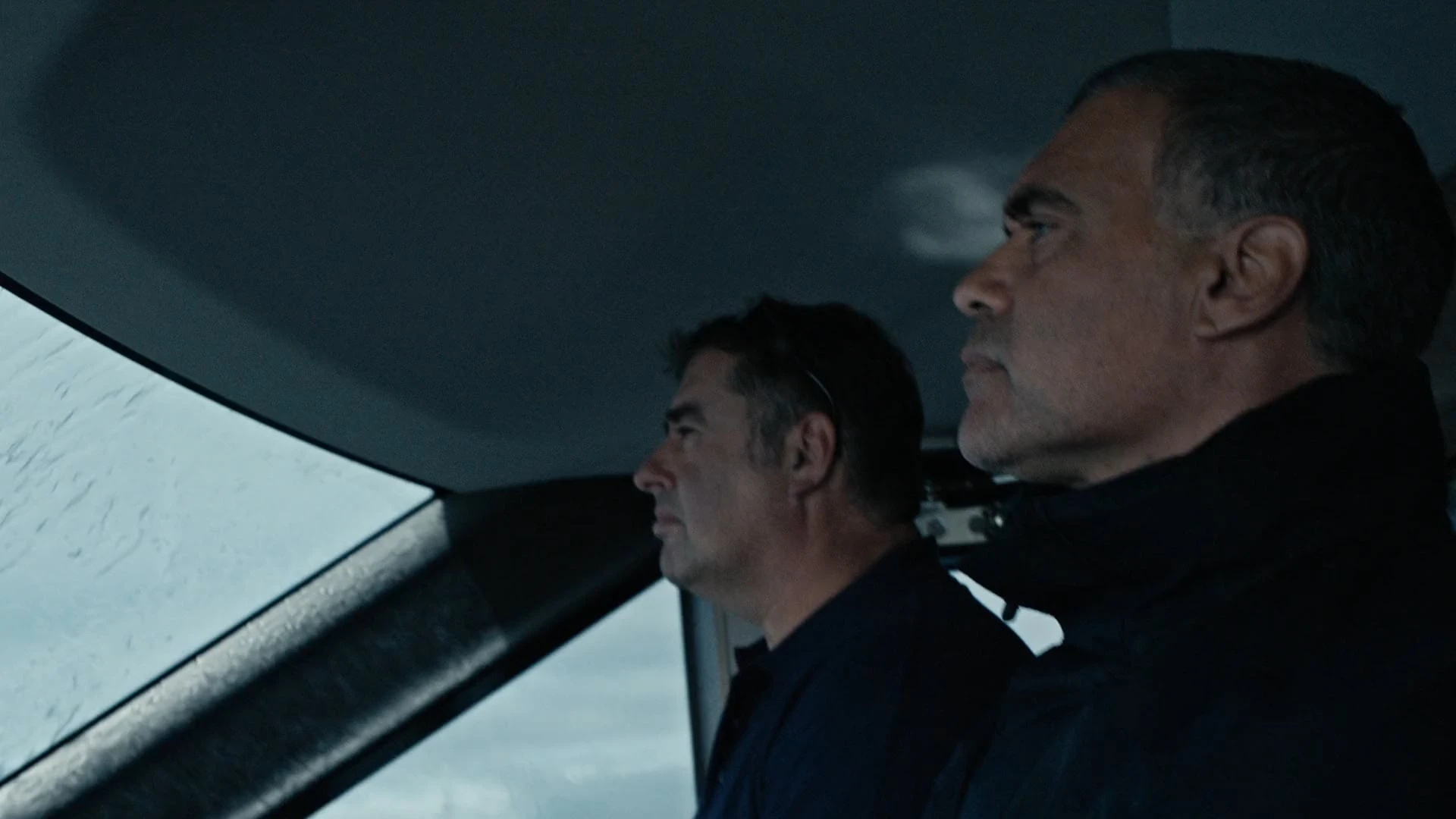
The final stages of a build bring the work together. Fit-out installs the prepared components and systems; tank testing and commissioning checks establish how they function as a complete boat. At Newport Street, sea trials take the yacht into the environment for which it has been made, with specialist equipment suppliers joining relevant parts of the testing process.
This is where the phrase detail maker acquires its real meaning. It describes a responsibility shared across the business, from a cabinetmaker matching panels to an engineer following a system through testing. The owner receives one yacht. Its coherence depends on many people recognising how their part contributes to the whole.
About Meet the detail makers
Enquiries are not enabled yet. No message will be sent.

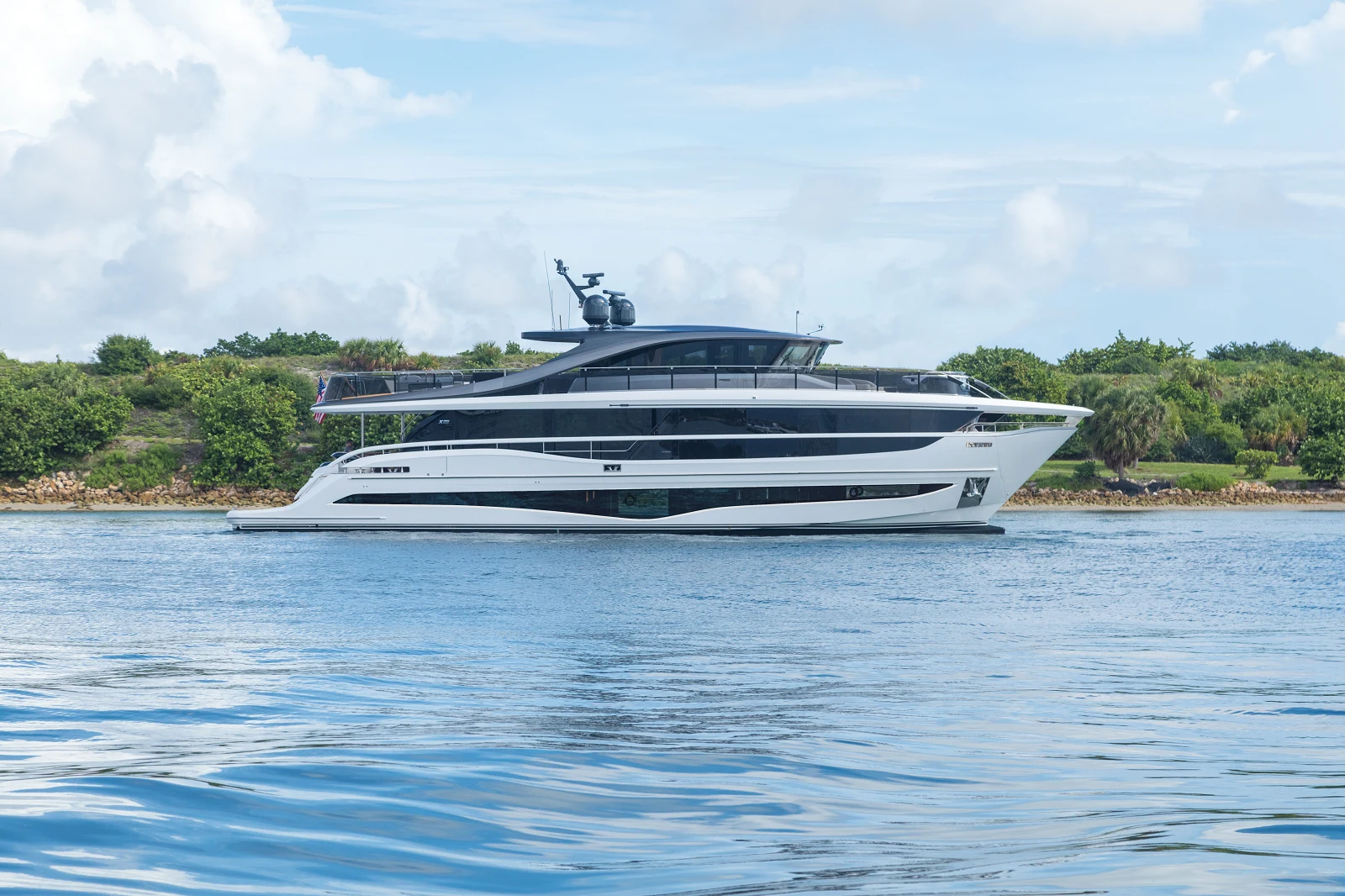
The X95 Vista is a useful place to see how Princess's manufacturing and design experience becomes a particular kind of yacht. At 29 metres, it belongs to the X Class's Super Flybridge approach, using the length of the boat to create a generous sequence of indoor and outdoor spaces rather than treating the upper deck as a small extra terrace.
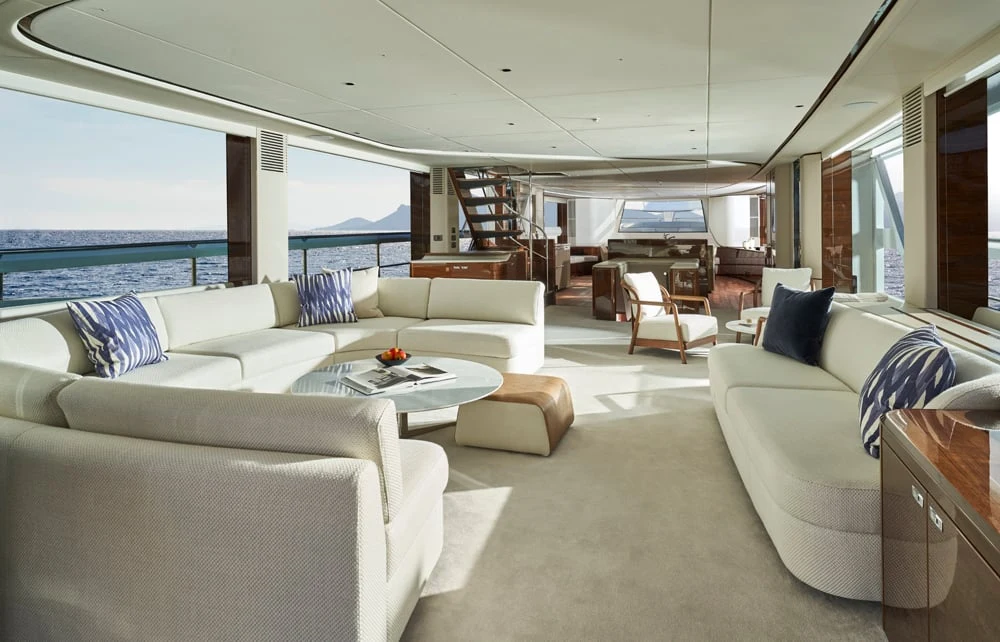
Its profile is defined by extensive glazing, including a long single-piece window and the broad windows of the main deck. Those elements are visually striking, but their purpose is felt from inside. They change the amount of daylight entering the accommodation and the way a room relates to the water beyond it.
The main-deck saloon offers a line of sight towards the forward window. The bow's open design language contributes to that view, so the connection with the surroundings is not restricted to sitting beside a side window. A long room can otherwise feel enclosed by its own arrangement; here, the outlook becomes part of its architecture.
An internal stair leads to the enclosed skylounge on the upper level. That creates a second substantial indoor setting, one that can be used in a different way from the main saloon. Guests can gather in more than one group, and the yacht can support a quieter space alongside a more sociable one without everyone having to retreat to a cabin.
The lower deck contains the full-beam master stateroom and a forward guest stateroom, both with en-suite facilities. Additional port and starboard cabins can be arranged with twin beds or converting doubles. The choice matters for a yacht that may host different combinations of family and friends over a season.
An optional fifth cabin provides another way to shape the accommodation. Rather than view every alternative as an extra item on a specification sheet, it is more useful to consider what kind of trip the owner wants to organise. More sleeping places, a particular private suite or a different balance of shared space will suit different programmes.
Crew accommodation is part of that same planning exercise. The standard arrangement provides separate crew quarters, with options that alter the number and distribution of berths. Guest spaces do not operate in isolation: the people looking after the boat need workable living and service areas of their own.
The yacht has a beam of 6.70 metres and a published draft of 2.03 metres. Those dimensions help explain both the available internal volume and the practical setting in which the boat will be used. A generous plan still has to work with the realities of berthing, routes and the spaces available at a destination.
Two MAN V12 engine options sit within the published specification. The manufacturer gives a maximum-speed range of 19 to 22 knots across those alternatives. The X95 Vista's character, however, is not captured by a top-speed figure alone. Its proposition also concerns the experience of spending sustained time aboard, with substantial room for living at several levels.
Fuel capacity is 13,818 litres, while fresh-water and waste-water systems form part of the wider service arrangement. These are the practical counterparts to the large saloon and outdoor areas. A yacht intended for extended enjoyment needs the capacities and systems that allow daily life to continue comfortably between stops.
The Vista development builds on the original X95, with the updated model unveiled at Palm Beach in March 2024. The progression shows how an established concept can evolve through changes in glazing, profile and arrangement. It is an exercise in refining the relationship between a proven platform and the way owners want to use it.
The result is a yacht whose most interesting luxury is choice: where to sit, which view to enjoy, how to accommodate guests and how much of the day to spend inside or out. The Plymouth story remains present in that experience, through the design decisions and the many manufactured details that turn the arrangement into a boat.
About X95 Vista: making room for the view
Enquiries are not enabled yet. No message will be sent.
Use the company’s official website for business enquiries about this article.
Contact Princess Yachts on its official website ↗
Princess Yachts Limited, Newport Street, Plymouth, PL1 3QG, United Kingdom | +44 (0)1752 203888
Image credit: Princess X95 Vista. Princess Yachts / Quin Bisset. Original image and credit . Image may be cropped for the layout.