

Explore a curated world of exceptional assets, from superyachts for sale and charter to luxury property and private jets. Whether you are looking to acquire, invest, or experience, we connect you with trusted opportunities and industry-leading expertise tailored to your requirements.
Aviation Sustainability
Sustainability is becoming an increasingly important focus within the private aviation industry. As global awareness of environmental issues grows, aircraft manufacturers, operators and fuel producers are exploring new technologies and operational practices designed to reduce the environmental impact of air travel.
Private aviation, like commercial aviation, faces the challenge of balancing the demand for air travel with the need to reduce emissions and improve efficiency.
In our view, sustainability will become one of the defining themes shaping the future of private aviation.
The environmental challenge
Aircraft engines traditionally rely on aviation fuel derived from fossil sources. The combustion of these fuels produces carbon dioxide and other emissions associated with climate change.
As a result, the aviation industry has begun exploring new approaches that aim to reduce emissions while maintaining safety and performance standards.
This transition is taking place across both commercial and private aviation sectors.
Sustainable aviation fuel
One of the most promising developments in aviation sustainability is the introduction of Sustainable Aviation Fuel (SAF). SAF is produced from renewable or waste-based sources and can significantly reduce lifecycle carbon emissions compared with traditional jet fuel.
Many private jet operators are beginning to incorporate SAF into their fuel supply chains where available.
Further insights into this area can be found in our Sustainable Aviation Fuel guide.
Aircraft efficiency improvements
Aircraft manufacturers continue to improve fuel efficiency through advances in aerodynamics, materials and engine design. Modern aircraft are significantly more efficient than earlier generations.
Lightweight composite materials, improved wing designs and more efficient engines all contribute to reduced fuel consumption.
These improvements are helping the industry reduce its environmental footprint over time.
Electric and hybrid aircraft research
Research into electric and hybrid aircraft technology is progressing rapidly. While fully electric aircraft are currently limited to smaller aircraft and short distances, the technology continues to develop.
Hybrid propulsion systems may provide an intermediate solution by combining traditional engines with electric propulsion.
These technologies could eventually reshape parts of the aviation sector.
Operational efficiency
Improving operational efficiency is another important aspect of aviation sustainability. Better flight planning, optimised routes and improved air traffic management can reduce fuel consumption.
Private aviation operators are increasingly adopting digital tools that help optimise flight operations and minimise unnecessary fuel use.
These improvements contribute to lower emissions across the aviation network.
Carbon offset programmes
Many private aviation operators offer carbon offset programmes that allow passengers to compensate for emissions associated with their flights. These programmes typically support environmental projects such as reforestation or renewable energy development.
While offsetting does not eliminate emissions, it represents one approach to addressing environmental impact.
Interest in offset programmes has grown significantly in recent years.
Airport sustainability initiatives
Airports are also implementing sustainability initiatives designed to reduce their environmental impact. These efforts may include renewable energy installations, electric ground vehicles and improved energy efficiency within terminal buildings.
Private aviation facilities are increasingly adopting similar measures.
These developments contribute to broader environmental improvements within the aviation ecosystem.
Industry collaboration
The transition toward sustainable aviation requires collaboration between aircraft manufacturers, fuel producers, operators and regulators. Industry organisations are working together to establish standards and accelerate the adoption of new technologies.
This collaborative approach is essential to achieving meaningful progress.
Many of these initiatives are supported by research partnerships and innovation programmes.
The future of sustainable aviation
While significant challenges remain, the aviation industry is actively pursuing solutions designed to reduce environmental impact. Continued investment in research and innovation will play a key role in achieving long-term sustainability goals.
Private aviation is likely to adopt many of these technologies as they become commercially viable.
This transition may gradually reshape how air travel operates in the future.
Final thoughts
Aviation sustainability is an evolving area that is attracting increasing attention across the industry. Advances in sustainable fuels, aircraft design and operational efficiency are helping reduce the environmental impact of air travel.
As technology continues to develop, these innovations are expected to play a growing role in the future of private aviation.


Recognition is not requested — it is earned. We identify and present exceptional companies operating at the highest level across superyachts, property, and private aviation. If your business meets the standard, inclusion places you alongside a trusted, carefully curated network recognised by a global audience.
Learn More..
Superyachts for Charter Guide | Luxury Charter Explained
Luxury Property for Sale in Spain | Investment & Lifestyle Guide
Superyachts for Sale Guide | Ownership, Costs & New Build Options
Superyacht Companies | Builders, Brokers & Superyachts for Sale
What Is Included on a Superyacht | Features, Amenities & Value
Average Cost of Owning a Superyacht | Running Costs & Value
Yacht vs Superyacht | Key Differences & Buying Guide
Motor Yachts vs Sailing Yachts | Key Differences & Buying Guide
Recognised Companies- Private Jets
Recognised Companies - Luxury Real Estate
Explore..
Luxury Property for Sale in Spain | Investment & Lifestyle Guide
How Long Does It Take to Build a Superyacht | New Build Timeline
How Many Crew Are Needed to Operate a Superyacht | Crew Guide
How Much Does It Cost to Build a Superyacht | New Build Pricing Guide
How Much Does It Cost to Charter a Superyacht | Charter Pricing Guide
How to Charter a Superyacht | Step-by-Step Charter Guide
Contact Introductions | Superyachts for Sale, Charter & Luxury Assets
Do Superyachts Make Money Through Charter | Investment & Returns Guide
Recognised Shipyards
Recognised Superyacht Charter Companies

Only the most exceptional companies are presented. We curate a select portfolio of superyachts, luxury property, and private aviation opportunities, ensuring every introduction reflects quality, credibility, and global appeal.
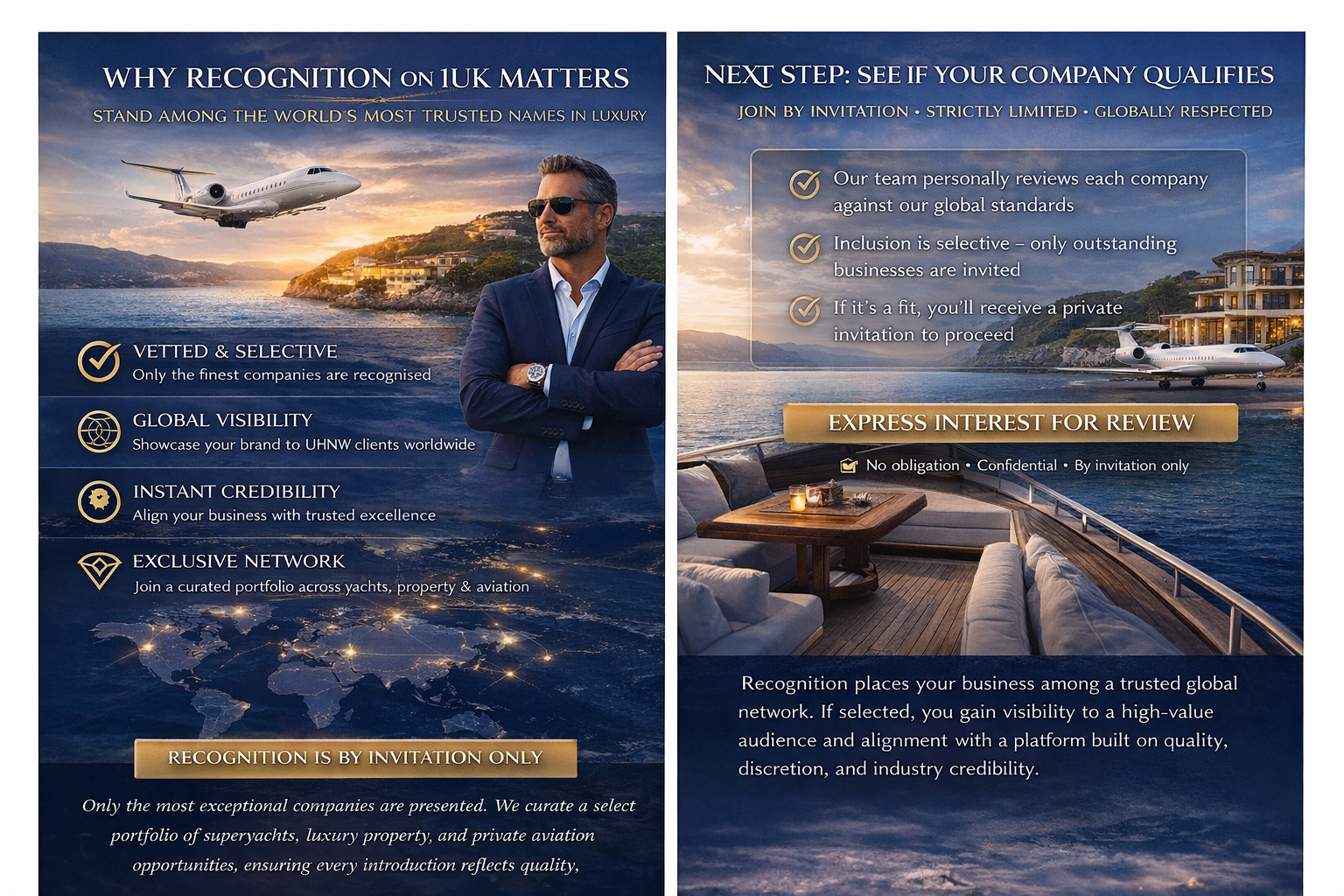
Recognition places your business among a trusted global network. If selected, you gain visibility to a high-value audience and alignment with a platform built on quality, discretion, and industry credibility.