

Explore a curated world of exceptional assets, from superyachts for sale and charter to luxury property and private jets. Whether you are looking to acquire, invest, or experience, we connect you with trusted opportunities and industry-leading expertise tailored to your requirements.
Yacht Innovation
The superyacht industry has long been associated with innovation. Shipyards, designers and technology companies continuously develop new solutions designed to improve yacht performance, efficiency and onboard experience. As yachts become larger and more technologically sophisticated, innovation plays an increasingly important role in shaping the future of the industry.
From advanced propulsion systems to cutting-edge interior design concepts, modern superyachts reflect the combined expertise of naval architects, engineers and designers working at the forefront of marine technology.
In our view, innovation is one of the defining characteristics of the superyacht sector and continues to push the boundaries of what is possible at sea.
Advances in yacht design
Modern yacht design has evolved significantly over the past two decades. Designers now focus not only on aesthetics but also on improving functionality, efficiency and guest experience.
Large glass panels, open deck spaces and seamless transitions between interior and exterior areas are now common features of contemporary yacht design.
These innovations allow owners and guests to enjoy greater connection with the surrounding environment while maintaining privacy and comfort.
Naval architecture and engineering
Naval architects play a critical role in the development of modern yachts. Their work focuses on hull design, stability and overall vessel performance.
Advances in computational modelling and hydrodynamic analysis have enabled designers to create hull forms that reduce resistance and improve fuel efficiency.
These improvements allow yachts to travel further while consuming less fuel.
Further insights into the technology behind these vessels can be found in our Yacht Technology guide.
Hybrid propulsion systems
One of the most significant areas of innovation within the superyacht sector is propulsion technology. Hybrid propulsion systems are increasingly being incorporated into new yacht designs.
These systems combine traditional diesel engines with electric propulsion technology, allowing yachts to operate more efficiently and reduce emissions in sensitive marine environments.
Hybrid technology also enables quieter operation, improving comfort for guests on board.
Energy management systems
Modern yachts incorporate sophisticated energy management systems designed to optimise the use of onboard power. These systems monitor and control electrical consumption throughout the vessel.
Advanced battery storage solutions are also beginning to play a role in improving energy efficiency and reducing reliance on traditional generators.
These developments form part of the broader movement toward Sustainable Yachting.
Materials and construction techniques
Innovations in materials have also influenced the construction of modern yachts. Lightweight composite materials and advanced aluminium structures are now widely used in yacht construction.
These materials improve structural strength while reducing overall weight, allowing yachts to achieve greater performance and efficiency.
Shipyards continue to explore new construction methods that enhance durability and reduce environmental impact.
Interior innovation
The interior spaces of modern yachts increasingly resemble those of luxury residences. Designers incorporate bespoke materials, advanced lighting systems and carefully crafted layouts to create unique onboard environments.
Entertainment systems, wellness facilities and fully equipped beach clubs are now common features on larger yachts.
These innovations enhance the onboard experience for owners and charter guests.
Smart yacht technology
Digital technology has become an integral part of modern yacht operation. Smart yacht systems allow crew and owners to control lighting, climate systems, security and entertainment through centralised digital interfaces.
These systems also allow remote monitoring of technical systems, helping crew maintain the vessel efficiently.
Connectivity technologies now provide high-speed internet access even when yachts are cruising in remote locations.
Exploration and expedition yachts
Innovation is also driving the development of expedition yachts designed for long-range exploration. These vessels are engineered to operate safely in remote and challenging environments.
Expedition yachts often incorporate reinforced hulls, extended fuel capacity and advanced navigation systems.
These vessels allow owners to explore destinations far beyond traditional cruising grounds.
The role of leading shipyards
Many of the world’s leading shipyards are at the forefront of yacht innovation. They collaborate with naval architects, technology providers and designers to develop new concepts and engineering solutions.
These shipyards continue to push the boundaries of yacht design and construction.
More information about these companies can be found in our section on Yacht Builders.
The future of yacht innovation
The next generation of superyachts is expected to focus heavily on sustainability, energy efficiency and alternative propulsion technologies.
Concept yachts already incorporate hydrogen fuel systems, advanced battery storage and solar integration designed to reduce environmental impact.
As these technologies mature, they are likely to influence the design of future yachts.
Final thoughts
Innovation remains central to the evolution of the superyacht industry. From advanced engineering to revolutionary design concepts, the sector continues to push technological boundaries.
These developments ensure that superyachts remain among the most sophisticated vessels ever built, combining exceptional luxury with remarkable engineering achievement.


Recognition is not requested — it is earned. We identify and present exceptional companies operating at the highest level across superyachts, property, and private aviation. If your business meets the standard, inclusion places you alongside a trusted, carefully curated network recognised by a global audience.
Learn More..
Superyachts for Charter Guide | Luxury Charter Explained
Luxury Property for Sale in Spain | Investment & Lifestyle Guide
Superyachts for Sale Guide | Ownership, Costs & New Build Options
Superyacht Companies | Builders, Brokers & Superyachts for Sale
What Is Included on a Superyacht | Features, Amenities & Value
Average Cost of Owning a Superyacht | Running Costs & Value
Yacht vs Superyacht | Key Differences & Buying Guide
Motor Yachts vs Sailing Yachts | Key Differences & Buying Guide
Recognised Companies- Private Jets
Recognised Companies - Luxury Real Estate
Explore..
Luxury Property for Sale in Spain | Investment & Lifestyle Guide
How Long Does It Take to Build a Superyacht | New Build Timeline
How Many Crew Are Needed to Operate a Superyacht | Crew Guide
How Much Does It Cost to Build a Superyacht | New Build Pricing Guide
How Much Does It Cost to Charter a Superyacht | Charter Pricing Guide
How to Charter a Superyacht | Step-by-Step Charter Guide
Contact Introductions | Superyachts for Sale, Charter & Luxury Assets
Do Superyachts Make Money Through Charter | Investment & Returns Guide
Recognised Shipyards
Recognised Superyacht Charter Companies

Only the most exceptional companies are presented. We curate a select portfolio of superyachts, luxury property, and private aviation opportunities, ensuring every introduction reflects quality, credibility, and global appeal.
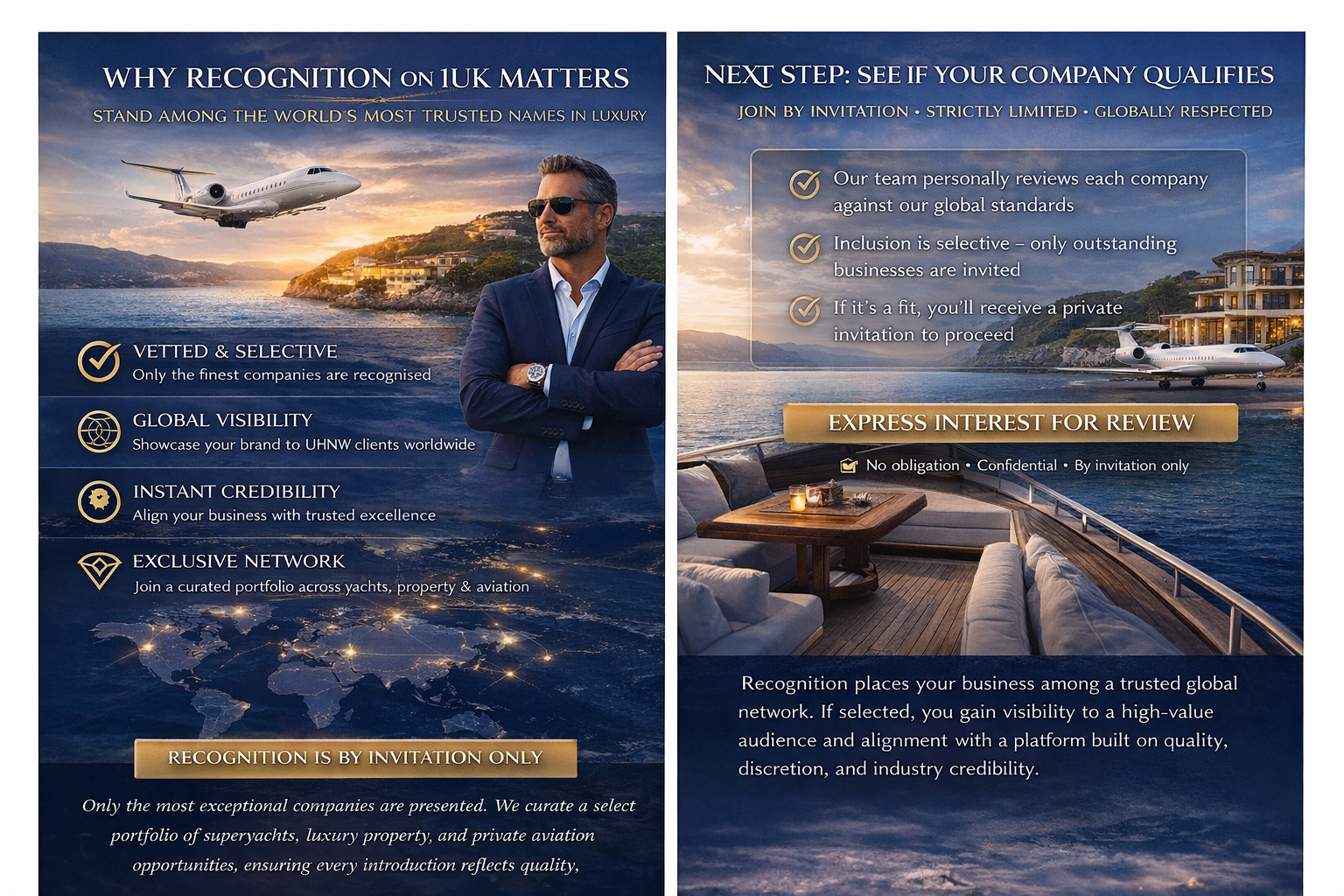
Recognition places your business among a trusted global network. If selected, you gain visibility to a high-value audience and alignment with a platform built on quality, discretion, and industry credibility.