

Explore a curated world of exceptional assets, from superyachts for sale and charter to luxury property and private jets. Whether you are looking to acquire, invest, or experience, we connect you with trusted opportunities and industry-leading expertise tailored to your requirements.
Yacht Sustainability
Sustainability has become an increasingly important topic within the superyacht industry. As environmental awareness grows, yacht builders, owners and operators are exploring new technologies and practices designed to reduce the environmental impact of large vessels.
Modern yachts are now incorporating innovative engineering solutions, improved efficiency and alternative energy systems in an effort to operate more responsibly.
In our view, sustainability will play a central role in shaping the future development of the yachting industry.
Environmental impact of superyachts
Superyachts are complex vessels that require energy for propulsion, onboard systems and guest comfort. Traditional propulsion systems rely on marine diesel engines, which generate emissions during operation.
As yachts have become larger and more technologically advanced, the industry has begun exploring ways to improve efficiency and reduce emissions.
This shift reflects broader changes taking place across the global maritime sector.
Hybrid propulsion systems
One of the most significant developments in sustainable yacht design is the introduction of hybrid propulsion systems. These systems combine conventional engines with electric motors and battery storage.
Hybrid systems allow yachts to operate in quieter, low-emission modes during certain parts of a voyage.
Further insights into these technologies can be found in our Hybrid Yachts guide.
Energy efficiency
Improving energy efficiency is another key focus for yacht designers and engineers. Advances in hull design, propulsion technology and onboard systems can significantly reduce fuel consumption.
Modern yachts often incorporate energy management systems that optimise the use of power onboard.
These systems help reduce unnecessary energy usage while maintaining high levels of comfort for guests.
Alternative fuels
The exploration of alternative fuels is an important area of research within the maritime sector. Biofuels, hydrogen and other emerging energy sources are being investigated as potential alternatives to traditional marine fuels.
While many of these technologies are still in development, they may eventually provide cleaner options for yacht propulsion.
The industry continues to monitor advancements in these areas.
Responsible cruising practices
Beyond technological improvements, sustainable yachting also involves responsible operational practices. Yacht crews are increasingly adopting procedures designed to minimise environmental impact.
These practices may include careful waste management, responsible anchoring and avoiding sensitive marine ecosystems.
Education and awareness among crew and guests play an important role in supporting these initiatives.
Marine conservation initiatives
Many organisations within the yachting industry are supporting marine conservation efforts aimed at protecting ocean ecosystems. Some yachts participate in scientific research projects or environmental monitoring programmes.
These initiatives contribute valuable data that can support conservation efforts around the world.
Yachts operating in remote environments are particularly well positioned to assist with research activities.
Design innovations
Yacht designers are increasingly exploring new materials and construction techniques that can improve environmental performance. Lightweight materials, improved insulation and efficient air conditioning systems all contribute to reduced energy consumption.
Innovative design approaches are helping to balance luxury expectations with environmental responsibility.
This area of development continues to evolve rapidly.
Owner and charter expectations
Owners and charter guests are becoming more conscious of environmental issues and are increasingly interested in sustainable options when selecting yachts.
This growing awareness is encouraging shipyards and designers to prioritise sustainability within their projects.
As demand for environmentally responsible solutions grows, the industry is likely to continue adapting.
Industry collaboration
The transition toward more sustainable yachting requires collaboration across the industry. Shipyards, designers, technology companies and regulatory bodies all play important roles in developing new solutions.
By working together, these stakeholders can help accelerate the adoption of environmentally responsible technologies.
This collaborative approach is essential for long-term progress.
Final thoughts
Sustainability is becoming a central consideration within the modern superyacht industry. Through advances in propulsion technology, energy efficiency and responsible operational practices, the industry is gradually reducing its environmental impact.
As technology continues to evolve and environmental awareness increases, sustainable yachting is likely to become an increasingly important aspect of the industry’s future.


Recognition is not requested — it is earned. We identify and present exceptional companies operating at the highest level across superyachts, property, and private aviation. If your business meets the standard, inclusion places you alongside a trusted, carefully curated network recognised by a global audience.
Learn More..
Superyachts for Charter Guide | Luxury Charter Explained
Luxury Property for Sale in Spain | Investment & Lifestyle Guide
Superyachts for Sale Guide | Ownership, Costs & New Build Options
Superyacht Companies | Builders, Brokers & Superyachts for Sale
What Is Included on a Superyacht | Features, Amenities & Value
Average Cost of Owning a Superyacht | Running Costs & Value
Yacht vs Superyacht | Key Differences & Buying Guide
Motor Yachts vs Sailing Yachts | Key Differences & Buying Guide
Recognised Companies- Private Jets
Recognised Companies - Luxury Real Estate
Explore..
Luxury Property for Sale in Spain | Investment & Lifestyle Guide
How Long Does It Take to Build a Superyacht | New Build Timeline
How Many Crew Are Needed to Operate a Superyacht | Crew Guide
How Much Does It Cost to Build a Superyacht | New Build Pricing Guide
How Much Does It Cost to Charter a Superyacht | Charter Pricing Guide
How to Charter a Superyacht | Step-by-Step Charter Guide
Contact Introductions | Superyachts for Sale, Charter & Luxury Assets
Do Superyachts Make Money Through Charter | Investment & Returns Guide
Recognised Shipyards
Recognised Superyacht Charter Companies

Only the most exceptional companies are presented. We curate a select portfolio of superyachts, luxury property, and private aviation opportunities, ensuring every introduction reflects quality, credibility, and global appeal.
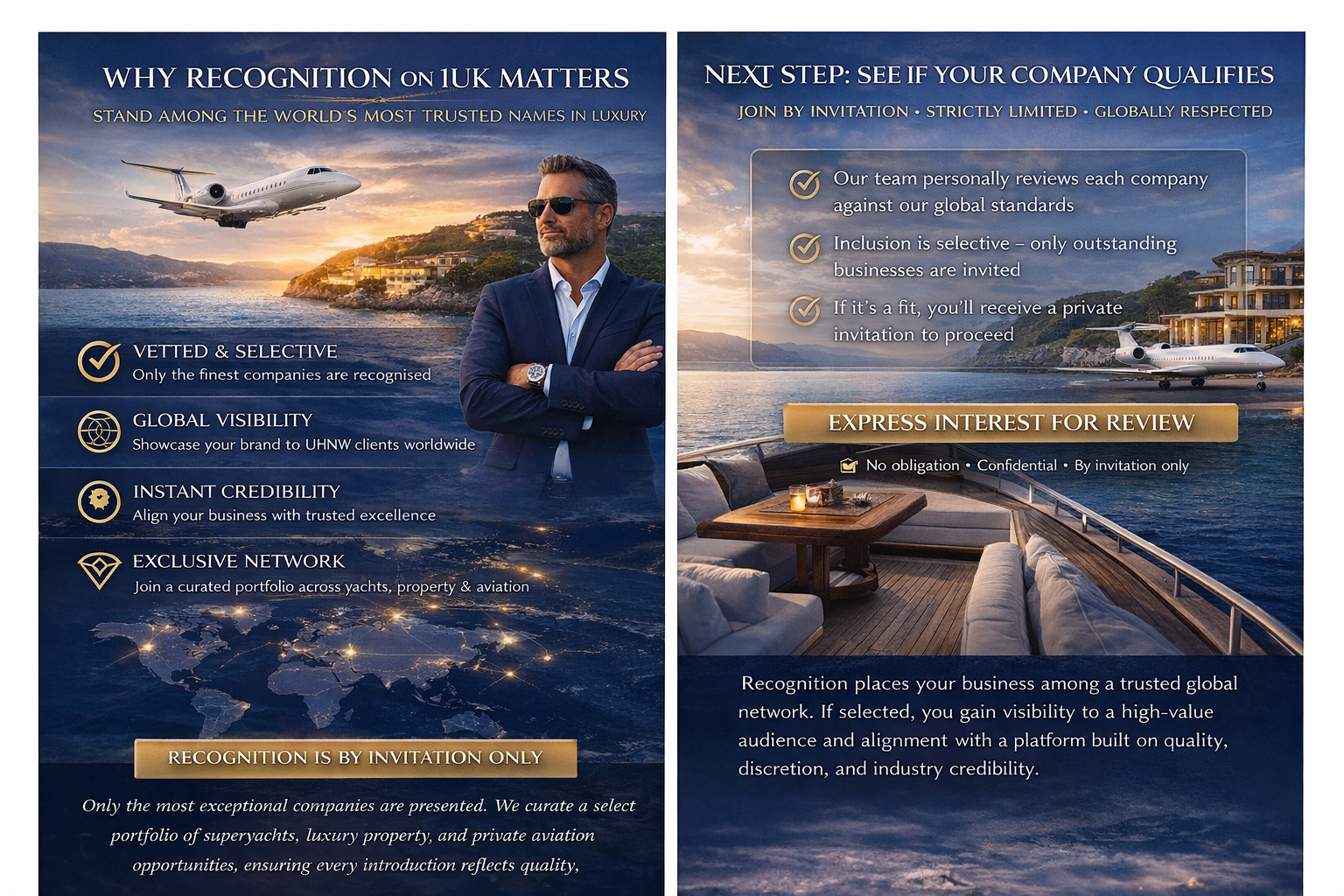
Recognition places your business among a trusted global network. If selected, you gain visibility to a high-value audience and alignment with a platform built on quality, discretion, and industry credibility.