

Explore a curated world of exceptional assets, from superyachts for sale and charter to luxury property and private jets. Whether you are looking to acquire, invest, or experience, we connect you with trusted opportunities and industry-leading expertise tailored to your requirements.
Future Standards
Future standards will play an increasingly important role in shaping industries such as superyachts, private aviation and luxury property. As technology evolves and global expectations change, industries must adapt to new regulatory frameworks, environmental requirements and operational practices.
Standards help ensure consistency, safety and quality across complex global industries.
In our view, the development of future standards will be essential in guiding responsible innovation and long-term industry growth.
The role of standards in modern industries
Standards provide structured guidelines that define how products, services and operations should be designed and delivered. These frameworks ensure that companies operate within recognised safety, quality and environmental requirements.
Without consistent standards, industries would struggle to maintain reliability and trust.
International standards organisations, industry bodies and regulatory authorities often work together to establish these frameworks.
Safety and operational standards
Safety remains one of the most important areas influenced by industry standards. In sectors such as aviation and maritime operations, strict safety requirements govern the design, construction and operation of vessels and aircraft.
These standards help protect passengers, crew members and the wider public.
Continuous review and improvement of safety standards ensures that new technologies and operational practices remain safe and reliable.
Environmental regulations
Environmental standards are becoming increasingly significant as industries respond to global sustainability goals. Governments and international organisations are introducing regulations designed to reduce emissions and protect natural environments.
These regulations influence vessel design, fuel use, construction methods and operational procedures.
Environmental standards are likely to become more comprehensive in the years ahead.
Further insights into sustainability developments can be found in our Industry Initiatives and Responsible Luxury guides.
Technological innovation and standards
Rapid technological innovation often requires new standards to ensure compatibility and safe implementation. As industries introduce technologies such as hybrid propulsion, digital systems and advanced materials, standards must evolve accordingly.
These frameworks help ensure that new technologies integrate safely into existing systems.
Standardisation also supports interoperability between equipment and infrastructure.
Digital and cybersecurity standards
As digital systems become more integrated into luxury assets and infrastructure, cybersecurity is emerging as an important area of regulation. Standards are being developed to protect systems from digital threats and ensure secure communication networks.
These standards are particularly important for systems that rely on satellite communication or remote connectivity.
Maintaining secure digital environments is essential for modern operations.
Global cooperation
Because industries such as aviation and maritime transport operate internationally, many standards must be developed through global cooperation. International regulatory organisations and industry groups work together to create guidelines that can be applied across multiple countries.
This cooperation ensures that standards remain consistent regardless of geographic location.
Global frameworks are essential for industries that operate across international borders.
Innovation balanced with regulation
One of the key challenges in developing future standards is balancing innovation with regulation. While new technologies can create significant opportunities, they must also meet strict safety and environmental requirements.
Standards therefore act as a bridge between innovation and responsible implementation.
Careful regulation ensures that progress does not compromise safety or environmental protection.
The role of industry organisations
Industry associations and professional organisations often contribute to the development of standards by representing the interests and expertise of companies operating within the sector.
These organisations provide valuable technical insight and help ensure that standards remain practical and effective.
Their involvement supports the creation of balanced and informed regulatory frameworks.
Adapting to future challenges
As global industries face new challenges such as climate change, technological disruption and changing consumer expectations, standards will continue to evolve.
Regulatory frameworks must remain flexible enough to adapt to emerging technologies while maintaining the principles of safety, quality and sustainability.
This adaptability will be essential in managing the rapid pace of innovation.
Final thoughts
Future standards will shape how industries operate in the coming decades. By establishing clear frameworks for safety, sustainability and technological integration, standards help guide responsible development.
As innovation continues across sectors such as superyachts, aviation and luxury property, these standards will ensure that progress is achieved in a safe, reliable and sustainable manner.


Recognition is not requested — it is earned. We identify and present exceptional companies operating at the highest level across superyachts, property, and private aviation. If your business meets the standard, inclusion places you alongside a trusted, carefully curated network recognised by a global audience.
Learn More..
Superyachts for Charter Guide | Luxury Charter Explained
Luxury Property for Sale in Spain | Investment & Lifestyle Guide
Superyachts for Sale Guide | Ownership, Costs & New Build Options
Superyacht Companies | Builders, Brokers & Superyachts for Sale
What Is Included on a Superyacht | Features, Amenities & Value
Average Cost of Owning a Superyacht | Running Costs & Value
Yacht vs Superyacht | Key Differences & Buying Guide
Motor Yachts vs Sailing Yachts | Key Differences & Buying Guide
Recognised Companies- Private Jets
Recognised Companies - Luxury Real Estate
Explore..
Luxury Property for Sale in Spain | Investment & Lifestyle Guide
How Long Does It Take to Build a Superyacht | New Build Timeline
How Many Crew Are Needed to Operate a Superyacht | Crew Guide
How Much Does It Cost to Build a Superyacht | New Build Pricing Guide
How Much Does It Cost to Charter a Superyacht | Charter Pricing Guide
How to Charter a Superyacht | Step-by-Step Charter Guide
Contact Introductions | Superyachts for Sale, Charter & Luxury Assets
Do Superyachts Make Money Through Charter | Investment & Returns Guide
Recognised Shipyards
Recognised Superyacht Charter Companies

Only the most exceptional companies are presented. We curate a select portfolio of superyachts, luxury property, and private aviation opportunities, ensuring every introduction reflects quality, credibility, and global appeal.
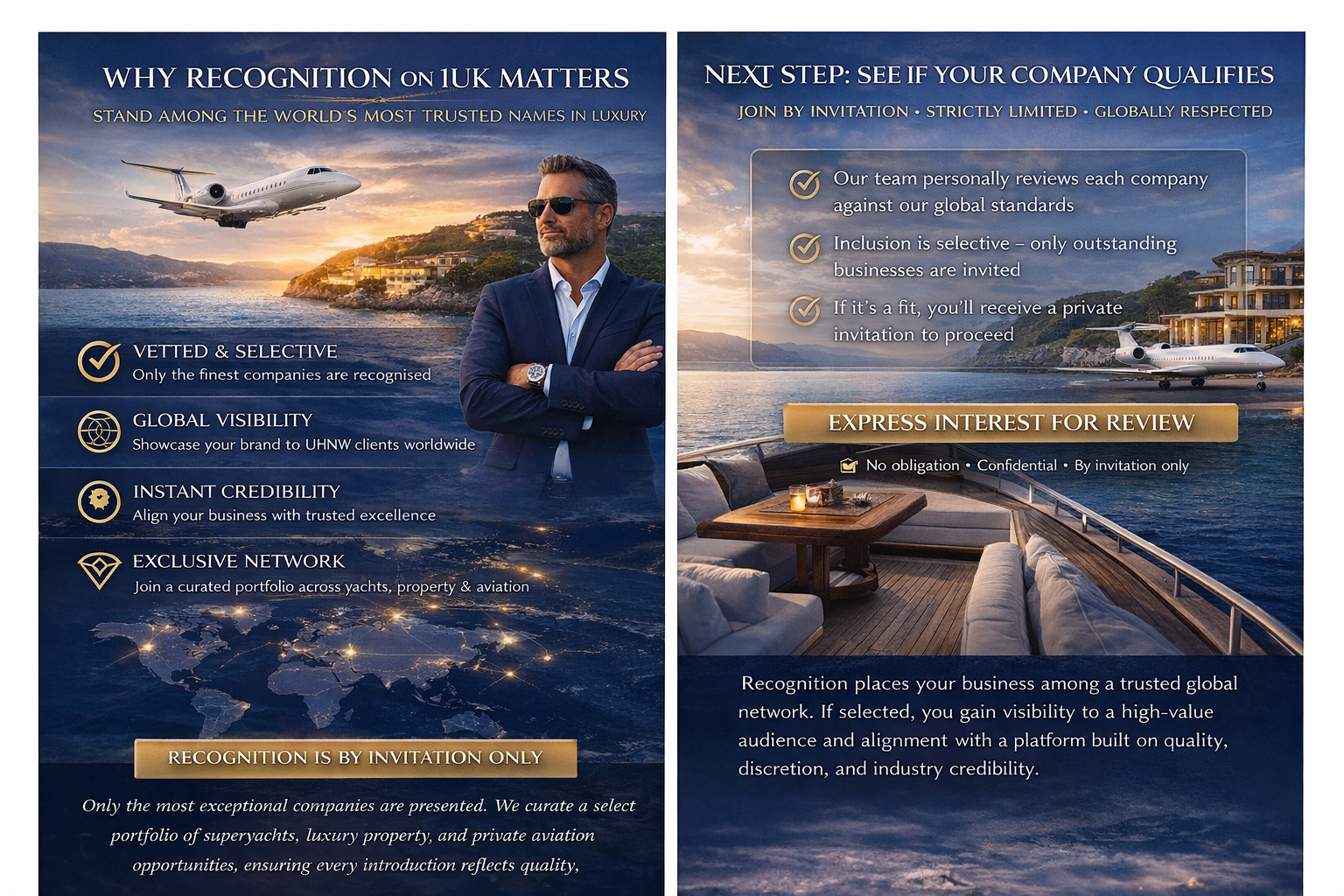
Recognition places your business among a trusted global network. If selected, you gain visibility to a high-value audience and alignment with a platform built on quality, discretion, and industry credibility.