
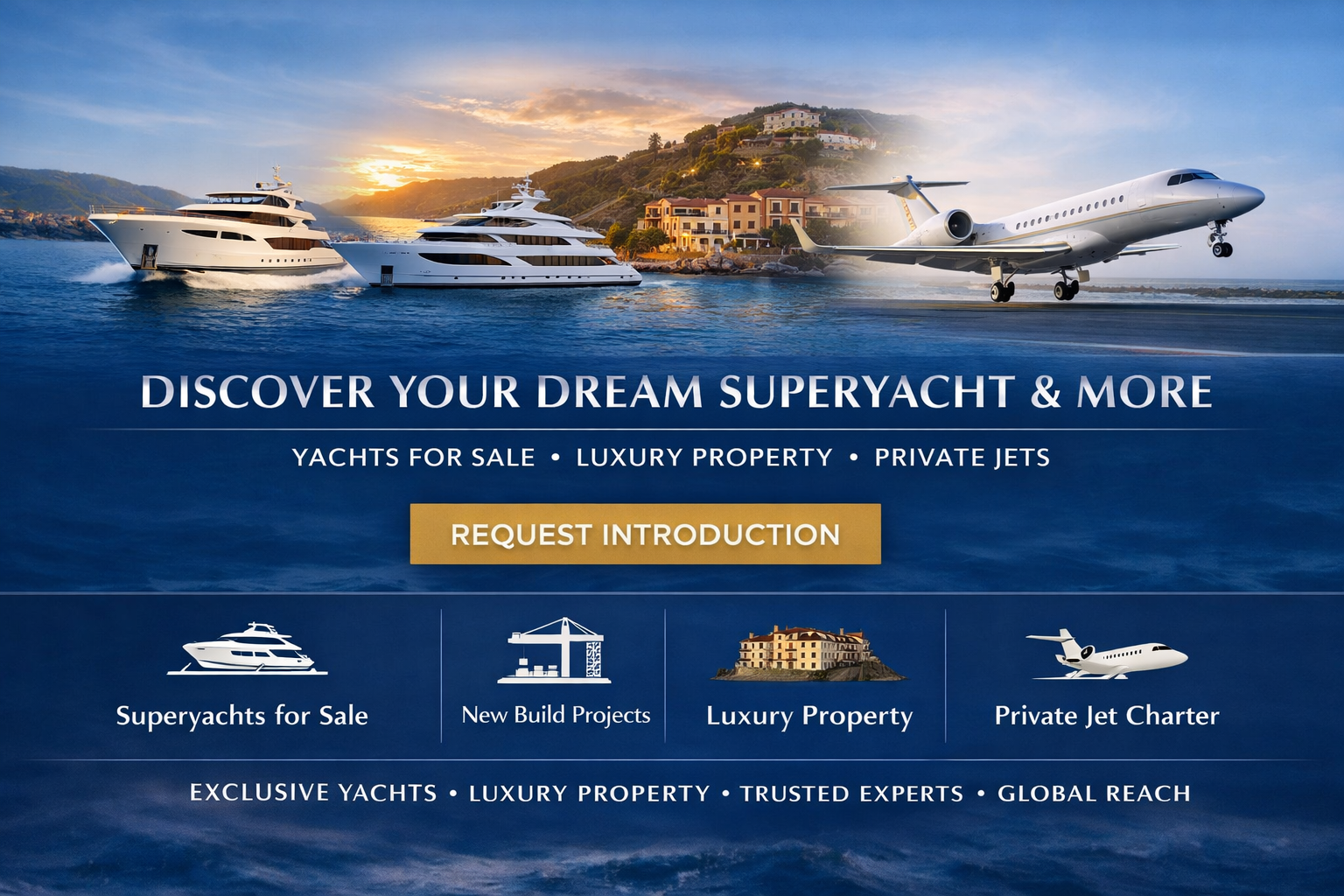
Explore a curated world of exceptional assets, from superyachts for sale and charter to luxury property and private jets. Whether you are looking to acquire, invest, or experience, we connect you with trusted opportunities and industry-leading expertise tailored to your requirements.
Responsible Luxury
The concept of responsible luxury and ESG is gaining increasing attention across industries such as superyachts, private aviation and high-end real estate. While luxury has traditionally been associated with exclusivity and exceptional quality, modern perspectives increasingly emphasise environmental responsibility, ethical practices and long-term sustainability.
Responsible luxury focuses on balancing exceptional experiences with an awareness of environmental and social impact.
In our view, responsible luxury will become a defining principle guiding the evolution of the global luxury industry.
The evolution of luxury values
Luxury has evolved significantly over the past several decades. While craftsmanship, quality and exclusivity remain central to luxury products and experiences, there is now growing awareness that these attributes must also be aligned with responsible practices.
Consumers are increasingly interested in understanding how products are produced, how resources are used and how businesses contribute to environmental and social wellbeing.
This shift is influencing how luxury brands operate and communicate their values.
Environmental responsibility
Environmental responsibility ESG is one of the key pillars of responsible luxury. Many organisations within the luxury sector are adopting practices designed to reduce environmental impact.
This may include energy-efficient design, sustainable materials and improved operational efficiency.
In industries connected to the ocean or air travel, such as yachting and aviation, environmental considerations are particularly important.
Further insights into environmental initiatives can be found in our Yacht Sustainability and Aviation Sustainability guides.
Ethical sourcing and production
Responsible luxury also involves ethical sourcing of materials and transparent supply chains. Businesses are increasingly expected to ensure that raw materials are obtained responsibly and that production processes meet high ethical standards.
This approach promotes fairness, environmental stewardship and long-term sustainability.
Transparency within supply chains is becoming an important expectation for many luxury consumers.
Longevity and quality
Luxury products are often distinguished by their durability and craftsmanship. Responsible luxury emphasises the value of long-lasting products that are designed to endure rather than be replaced frequently.
This philosophy supports sustainability by reducing resource consumption over time.
High-quality design and construction therefore play an important role in responsible luxury.
Innovation and sustainability
Innovation is enabling new approaches to responsible luxury. Advances in engineering, materials and digital technology are helping companies develop solutions that improve both performance and sustainability.
These innovations allow businesses to maintain the standards expected in luxury markets while reducing environmental impact.
Technological progress will continue to shape the future of responsible luxury.
Experiential luxury
Many modern luxury consumers are shifting their focus from material goods to experiences. Travel, exploration and cultural engagement are increasingly valued over traditional forms of luxury consumption.
This shift aligns well with responsible luxury, as experiential travel often encourages appreciation of natural environments and cultural heritage.
Responsible tourism practices play an important role in supporting this approach.
Industry leadership
Leadership within the luxury sector is increasingly defined by a commitment to responsible practices. Companies that demonstrate environmental awareness and ethical behaviour are often viewed as pioneers within their industries.
By adopting responsible approaches, organisations can contribute positively to the broader global community.
This leadership helps set new standards for the industry as a whole.
Consumer expectations
Consumer expectations are evolving rapidly. Buyers and clients increasingly expect luxury brands to demonstrate environmental responsibility, transparency and ethical behaviour.
Businesses that fail to address these expectations may find it increasingly difficult to maintain credibility in a changing market.
Responsible luxury is therefore becoming an important element of brand reputation.
The future of responsible luxury
As environmental awareness and global sustainability efforts continue to expand, responsible luxury is likely to become a fundamental part of how luxury industries operate.
Innovation, ethical sourcing and environmental stewardship will shape the next generation of luxury products and experiences.
This transformation reflects a broader shift toward sustainability across many sectors of the global economy.
Final thoughts
Responsible luxury represents an evolving philosophy that combines exceptional quality with environmental and social responsibility. By integrating sustainability into design, production and operations, the luxury industry can continue to deliver remarkable experiences while supporting long-term environmental stewardship.
As expectations continue to evolve, responsible luxury will play an increasingly important role in defining the future of the global luxury market.
1uk.com is partner with Full Circle International and our director is the sponsorship director of the project, which is a round the world challenge to promote clean fuel with 30% less emissions, the yacht called Spirit of Challenge will be crewed by limbless veterans.


Recognition is not requested — it is earned. We identify and present exceptional companies operating at the highest level across superyachts, property, and private aviation. If your business meets the standard, inclusion places you alongside a trusted, carefully curated network recognised by a global audience.
Learn More..
Superyachts for Charter Guide | Luxury Charter Explained
Luxury Property for Sale in Spain | Investment & Lifestyle Guide
Superyachts for Sale Guide | Ownership, Costs & New Build Options
Superyacht Companies | Builders, Brokers & Superyachts for Sale
What Is Included on a Superyacht | Features, Amenities & Value
Average Cost of Owning a Superyacht | Running Costs & Value
Yacht vs Superyacht | Key Differences & Buying Guide
Motor Yachts vs Sailing Yachts | Key Differences & Buying Guide
Recognised Companies- Private Jets
Recognised Companies - Luxury Real Estate
Explore..
Luxury Property for Sale in Spain | Investment & Lifestyle Guide
How Long Does It Take to Build a Superyacht | New Build Timeline
How Many Crew Are Needed to Operate a Superyacht | Crew Guide
How Much Does It Cost to Build a Superyacht | New Build Pricing Guide
How Much Does It Cost to Charter a Superyacht | Charter Pricing Guide
How to Charter a Superyacht | Step-by-Step Charter Guide
Contact Introductions | Superyachts for Sale, Charter & Luxury Assets
Do Superyachts Make Money Through Charter | Investment & Returns Guide
Recognised Shipyards
Recognised Superyacht Charter Companies
Only the most exceptional companies are presented. We curate a select portfolio of superyachts, luxury property, and private aviation opportunities, ensuring every introduction reflects quality, credibility, and global appeal.
Recognition places your business among a trusted global network. If selected, you gain visibility to a high-value audience and alignment with a platform built on quality, discretion, and industry credibility.