

Explore a curated world of exceptional assets, from superyachts for sale and charter to luxury property and private jets. Whether you are looking to acquire, invest, or experience, we connect you with trusted opportunities and industry-leading expertise tailored to your requirements.
Sustainability Introduction
Sustainability and ESG has become one of the most important themes influencing modern industries, including superyachts, private aviation and luxury property. As environmental awareness grows and global challenges become more visible, businesses and individuals are increasingly considering how luxury experiences can be delivered responsibly.
Sustainability is no longer viewed simply as an environmental issue, but as a broader commitment to responsible development, efficient use of resources and long-term stewardship of the planet.
In our view, sustainability will become a defining influence shaping the future of the global luxury sector.
Understanding sustainability
Sustainability refers to the ability to meet present needs without compromising the ability of future generations to meet their own. In practical terms this means reducing environmental impact, improving efficiency and ensuring that economic activity supports long-term environmental health.
Many industries are now incorporating sustainability principles into design, manufacturing and operational processes.
This shift reflects a growing recognition that long-term success depends on responsible resource management.
ESG
Environmental, Social and Governance (ESG) principles are becoming a defining standard across the luxury maritime and lifestyle sectors, shaping how businesses operate, invest, and grow responsibly. For the superyacht industry in particular, ESG goes beyond compliance—embracing cleaner propulsion technologies, sustainable materials, ethical supply chains, and transparent governance. Owners, operators, and suppliers are increasingly expected to demonstrate measurable commitments to reducing environmental impact, supporting crew welfare, and maintaining the highest standards of accountability. At 1UK, ESG represents not only a responsibility but an opportunity: to align innovation with integrity, enhance long-term asset value, and position forward-thinking brands at the forefront of a more sustainable and credible global luxury market.
Join us on this journey and get in touch for more information
Sustainability across luxury industries
Luxury sectors are increasingly integrating sustainability into their strategies. Superyacht builders are developing hybrid propulsion systems and more efficient vessel designs. Aviation companies are exploring sustainable fuels and improved aircraft efficiency.
Luxury property developers are also incorporating renewable energy systems, energy-efficient construction methods and environmentally responsible materials.
These developments demonstrate how sustainability is influencing multiple sectors simultaneously.
Environmental responsibility
Environmental responsibility lies at the heart of sustainability initiatives. Companies and organisations are working to reduce emissions, minimise waste and protect natural ecosystems.
Industries connected to oceans, air travel and coastal environments are particularly focused on reducing their environmental footprint.
These efforts are explored further in our Yacht Sustainability and Aviation Sustainability guides.
Technological innovation
Technology is playing a major role in enabling sustainable solutions. Advances in engineering, materials science and digital systems are helping industries reduce energy consumption and improve operational efficiency.
Hybrid propulsion, renewable energy integration and smart building systems are examples of technologies supporting sustainability goals.
These innovations allow industries to maintain performance while improving environmental outcomes.
Changing consumer expectations
Consumer expectations are also evolving. Many individuals now prefer brands and experiences that demonstrate environmental responsibility and ethical practices.
This shift in expectations is encouraging businesses to adopt sustainable practices as part of their long-term strategy.
Responsible luxury is becoming an increasingly important concept within the global luxury market.
Industry collaboration
Sustainability initiatives often require collaboration between multiple organisations. Industry associations, research institutions and technology companies frequently work together to develop new solutions and share knowledge.
This collaborative approach helps accelerate innovation and improve the effectiveness of sustainability initiatives.
Partnerships across sectors are often essential for achieving meaningful progress.
Global environmental challenges
Environmental challenges such as climate change, ocean pollution and resource depletion are influencing how industries operate. Addressing these issues requires coordinated efforts from governments, businesses and individuals.
Many industries are now developing strategies that align with international environmental goals.
These efforts are shaping the direction of future development.
Long-term industry transformation
The integration of sustainability into luxury industries represents a long-term transformation rather than a temporary trend. As technology improves and awareness grows, sustainability is likely to become embedded within industry standards and operational practices.
This transformation may influence everything from design and engineering to marketing and consumer engagement.
The transition toward sustainable practices is expected to continue accelerating.
The importance of responsible innovation
Responsible innovation is a key component of sustainable development. New technologies and design approaches must be implemented in ways that balance performance, efficiency and environmental responsibility.
By aligning innovation with sustainability principles, industries can create solutions that support long-term environmental and economic stability.
This balanced approach is essential for sustainable progress.
Final thoughts
Sustainability is becoming an essential element of modern industry and luxury markets. By embracing responsible practices, technological innovation and environmental stewardship, industries can continue to evolve while protecting natural resources.
As awareness grows and new solutions emerge, sustainability will play a central role in shaping the future of luxury travel, property development and global industry.


Recognition is not requested — it is earned. We identify and present exceptional companies operating at the highest level across superyachts, property, and private aviation. If your business meets the standard, inclusion places you alongside a trusted, carefully curated network recognised by a global audience.
Learn More..
Superyachts for Charter Guide | Luxury Charter Explained
Luxury Property for Sale in Spain | Investment & Lifestyle Guide
Superyachts for Sale Guide | Ownership, Costs & New Build Options
Superyacht Companies | Builders, Brokers & Superyachts for Sale
What Is Included on a Superyacht | Features, Amenities & Value
Average Cost of Owning a Superyacht | Running Costs & Value
Yacht vs Superyacht | Key Differences & Buying Guide
Motor Yachts vs Sailing Yachts | Key Differences & Buying Guide
Recognised Companies- Private Jets
Recognised Companies - Luxury Real Estate
Explore..
Luxury Property for Sale in Spain | Investment & Lifestyle Guide
How Long Does It Take to Build a Superyacht | New Build Timeline
How Many Crew Are Needed to Operate a Superyacht | Crew Guide
How Much Does It Cost to Build a Superyacht | New Build Pricing Guide
How Much Does It Cost to Charter a Superyacht | Charter Pricing Guide
How to Charter a Superyacht | Step-by-Step Charter Guide
Contact Introductions | Superyachts for Sale, Charter & Luxury Assets
Do Superyachts Make Money Through Charter | Investment & Returns Guide
Recognised Shipyards
Recognised Superyacht Charter Companies

Only the most exceptional companies are presented. We curate a select portfolio of superyachts, luxury property, and private aviation opportunities, ensuring every introduction reflects quality, credibility, and global appeal.
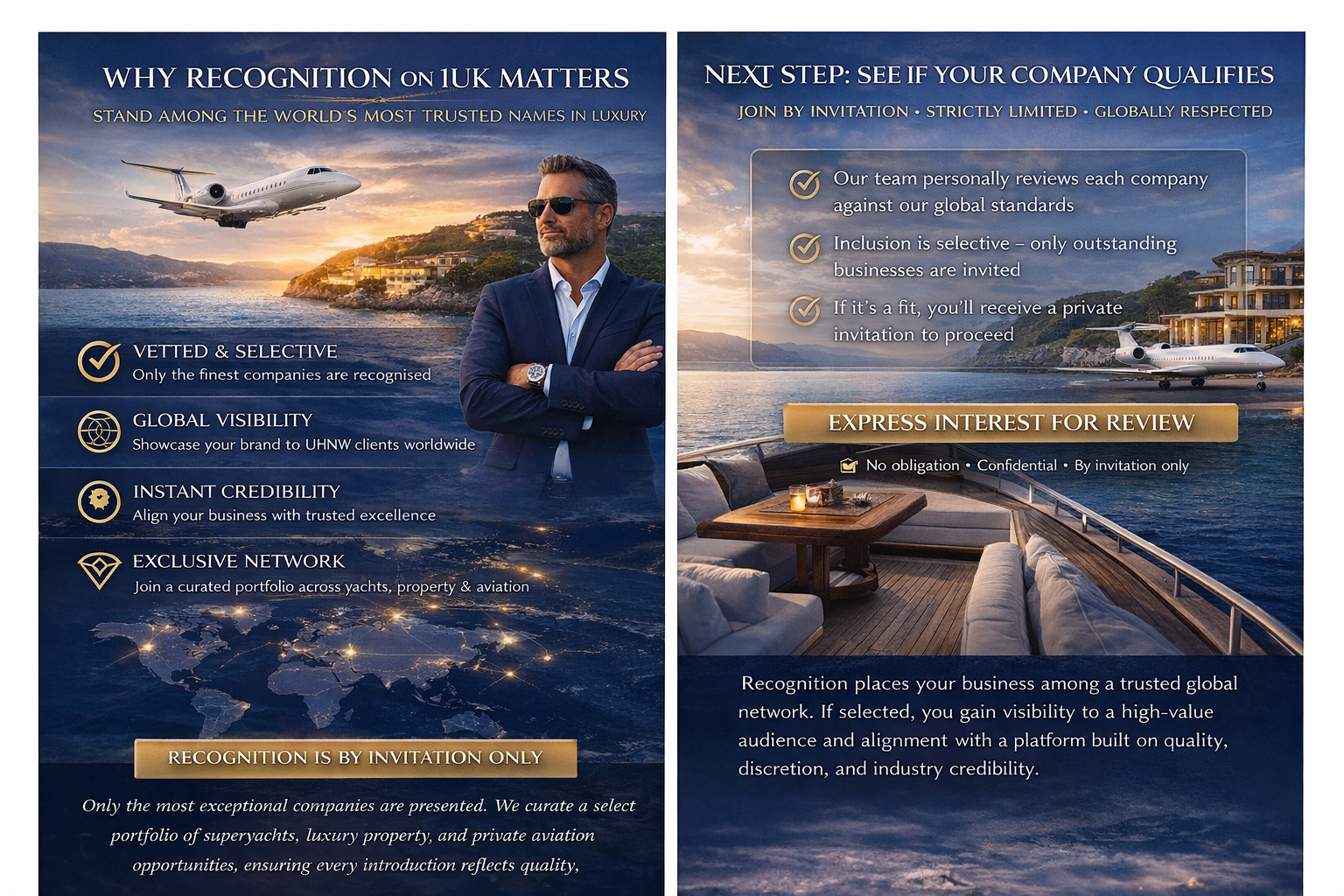
Recognition places your business among a trusted global network. If selected, you gain visibility to a high-value audience and alignment with a platform built on quality, discretion, and industry credibility.
Explore Sustainability in the Luxury Industries
Sustainability has become an increasingly important focus across the superyacht, private aviation and luxury property sectors. Innovation, responsible practices and new technologies are shaping how the luxury industry approaches environmental responsibility while maintaining exceptional standards of design and performance.
The following guides explore sustainability initiatives, emerging technologies and future developments across these industries.